
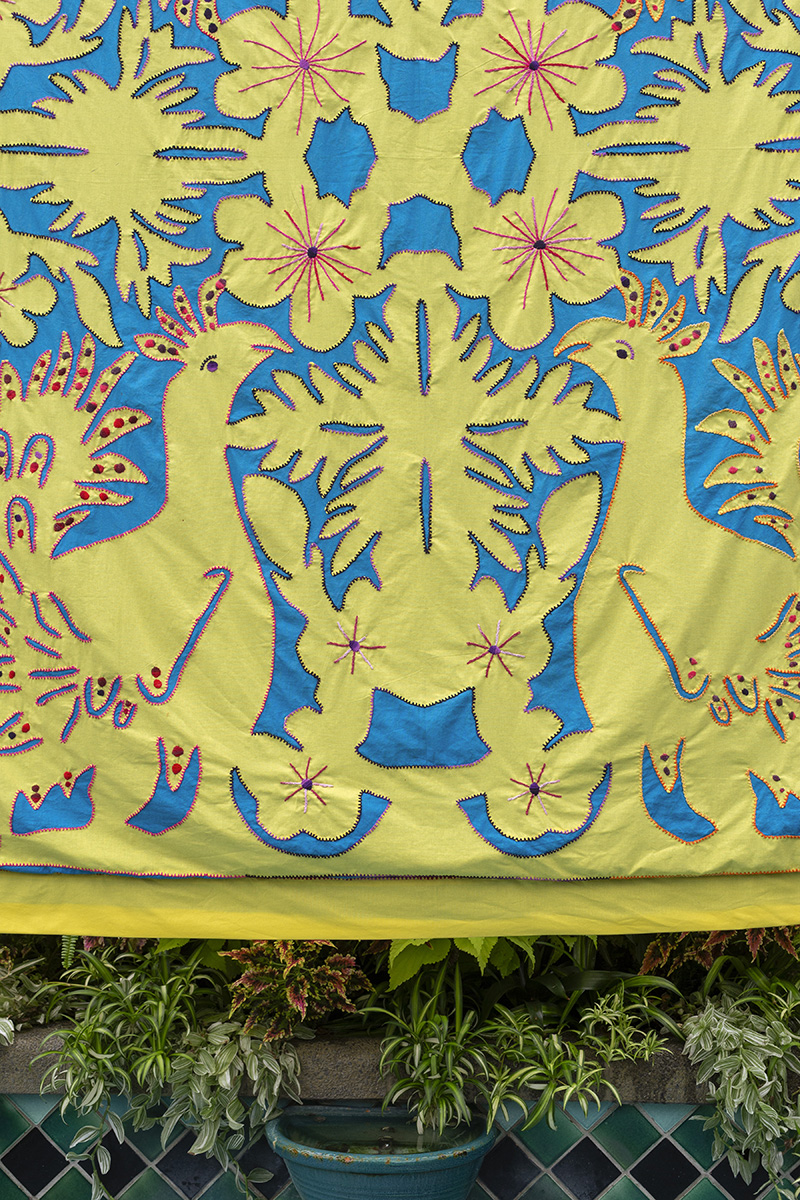
Moara’ora’o (Peacock) by Te Tua o Te Rai Akaiti Samuel. Photo courtesy of Cheska Brown and Enjoy Contemporary Art Space.
Stitching stories by Alessia Belsito-Riera
Tīpurepure ‘Au Vaine is a tīvaivai (quilt) collective that has gathered every Thursday in Porirua since 2019. Rooted in a proud lineage of Cook Islands va’inetini (women’s groups) and au va’ine (women’s guilds), they come together to sustain, celebrate, and evolve the artform of tīvaivai and the social practice accompanying it. Through making, they nurture language, kinship, and culture, creating a space for Cook Islands identity to thrive in Aotearoa.
The collective, alongside member and curator Tehani Buchanan-Whaipooti, present Tīpurepure ‘Au Vaine at Pātaka Art + Museum from the 7th of December until the 8th of March. The exhibition will transform the gallery into a living, breathing space where communal making collides with a rotating display of new works and tīvaivai selected from public collections. With the goal to reconnect makers with historical patterns, techniques, and the stories stitched into every piece, Buchanan-Whaipooti says that Tīpurepure ‘Au Vaine “gives a feeling of being enveloped by the natural environment of the islands”.
“Tīvaivai is a practice that has evolved from quilting brought over to the Cook Islands and across the Pacific by the wives of early European missionaries. Despite the colonial influences, the style and process of making tīvaivai is distinctly Cook Islands. Our mamas were and are creative and innovative, creating forms and colour palettes reminiscent of our island home,” Buchanan-Whaipooti says. “As an artform, tīvaivai has replaced tapa (barkcloth), the function and nature of tapa production now transferred to tīvaivai. So you could also say that tīvaivai has roots in our traditional tapa making. It is my hope that through my current work for this exhibition – a kuru (breadfruit) pattern embroidered onto tapa – our people remember and are inspired to revitalise tapa making as well.”
The communal making aspect of the exhibition was inspired when Buchanan-Whaipooti’s “tuakana and co-curator Ioana Gordon-Smith came up with the idea to include a making table in the exhibition, so our group has the opportunity to sew together in the gallery. The process of tīvaivai is never an isolated event. Rather, the act of making is done within the collective. Both the process of making and the tīvaivai itself are equally important to the cultural practice of tīvaivai so it makes sense that we would include communal making and engagement with our community as part of the exhibition.
While formal curatorial work is new to the artist, she says she has always ‘curated,’ particularly in her home. “I love discovering the stories and whakapapa of a piece of art or object, and how the mauri (life essence) of each piece can enhance and breathe life into a space. Curation allows me to create and hold space for works and stories that are important to me and in turn, our collective consciousness. Bringing together a collection of tīvaivai was a natural starting point stemming from my time learning tīvaivai with the mamas of Tīpurepure ‘Au Vaine and a desire to see our traditional artforms elevated and celebrated as exactly that... art.”
View more articles from:
« Issue 258, December 2, 2025