

Ascension: Schumann & Vaughan Williams
Presented by: New Zealand Symphony Orchestra
Conducted by: André de Ridder
Michael Fowler Centre, 9th Aug 2025
Reviewed by: Tamsin Evans
While Tāwhirimātea (Māori god of wind and weather) and Te Ihorangi (Māori god of rain) reminded us we are still looking forward to spring in Wellington, the NZSO lifted our spirits to remind us the blast of winter will give way to the new season soon in Ascension, the second concert of their Rumakina Immerse Festival.
Vesa-Matti Leppänen, playing the now, sadly, late Michael Hill’s own violin, took to the skies as The Lark Ascending, an early 20th-century English classic. The violin has a beautiful tone, bringing light and shade to the birdsong even when the lark was at his highest. We have skylarks in New Zealand too and Ralph Vaughan Williams’ evocation of English skies and rolling hills translates into our landscape and light.
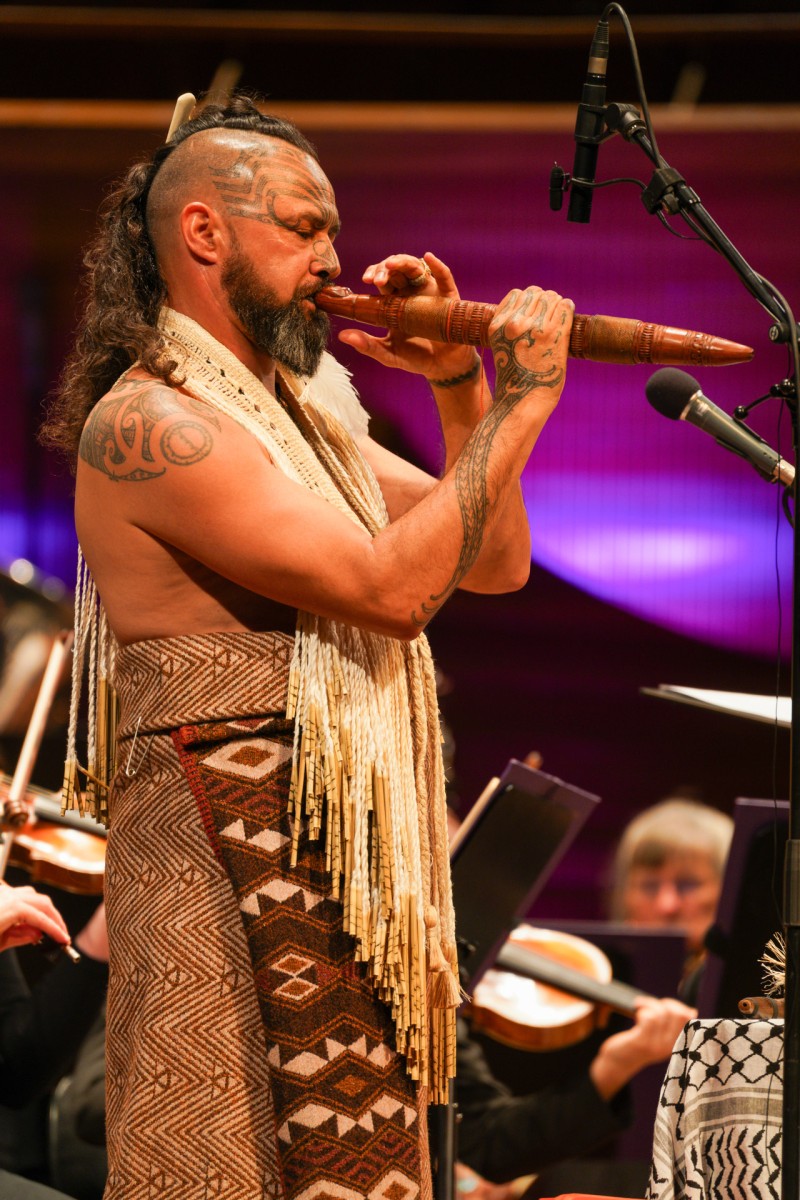
Papatūānuku is the outcome of a remarkable collaboration between taonga pūoro expert Jerome Kavanagh Poutama and composer Salina Fisher. In his pre-concert talk, Poutama spoke of how his music is all held in his head, each piece bound to a memory of the time, place, and event of its creation. Fisher’s orchestration was written to wrap around and support Poutama’s melodies and there were some beautiful matches between traditional orchestral instruments and the many taonga pūoro (singing treasures) Poutama used to give voice to Papatūānuku, the Earth Mother. A wonderful instrumental rendition of the dawn chorus instantly reminded me of hearing that amazing natural phenomenon on Kapiti Island, a conservation reserve rich in birdlife. The fluttering, twittering, flurrying, and calling on stage was as close to the real thing as you could get.
In contrast, Robert Schumann’s Symphony No. 1 Spring is firmly of the classic Romantic era. Traditional in form and more familiar to the ear than Papatūānuku, the sound was perfectly balanced and expertly played. Conductor André De Ridder’s direction was joyful, directive but nuanced and engaging. We will all look forward to seeing more of him when he takes up the role of NZSO’s musical director from 2027. Haere mai, Maestro!
View more reviews:
« Click here