
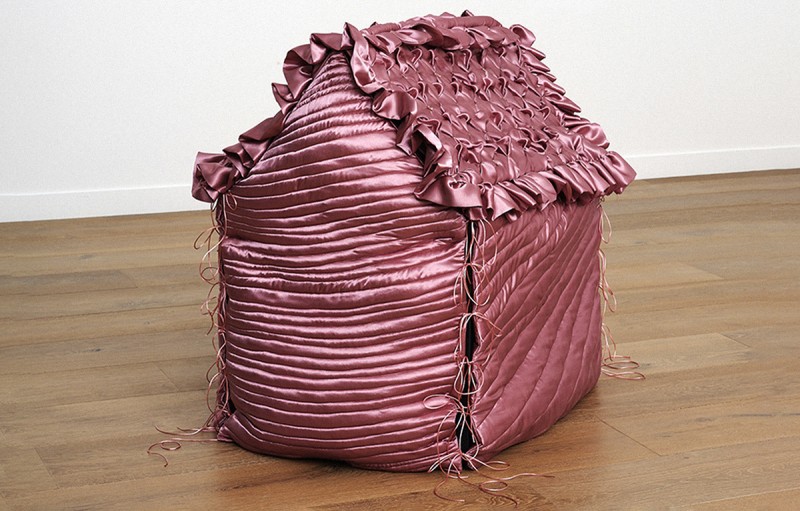
Dole House by Ming Ranginui
Photo by Samuel Hartnett
When contexts collide by Isabella Smith
Ihi is described as an inner force. A type of internal magnetism that emerges from an individual to drive their endeavours.
Three tactile, emerging artists Axel Iva, Te Ara Minhinnick, and Ming Ranginui bring their physical manifestations of ihi – embodying the way artists draw us in through their artworks – to the upcoming exhibition at Pātaka Gallery in Porirua, on display from the 28th of March to the 19th of July.
Curated by Israel Randell and Ioana Gordon-Smith, each of the artworks on display play with familiarity and unfamiliarity, and involve a change in position – lifting, suspending, shaping, rebuilding.
Ihi is a transformative energy. It reminds us that the apparent stability of an object can be made to shift and move when put under pressure. Whether this be taking it out of its original environment or creating known objects out of unlikely materials: a marae made from pink satin smock, a fale umu made of sheets of polycarbonate twin wall, muka (flax fibre) becoming a belly button.
“All of the artists are interested, in some way, in transitions and transformation. All of them consider how forms, and the meanings of those forms, shift when contexts collide, whether through migration or colonisation”, Gordon-Smith says. “Similarly, this is at play when a fale umu is constructed here in Aotearoa, when marae are erected in Australia.”
It is clear what makes the work of these artists a compelling and natural expression of ihi. A designer hailing from Samoa, Iva’s work is a hybrid of contrasting variables, blending graphic design with craft to explore semantics, semiotics, and Samoan life.
Ranginui (Te Āti Haunui-a-Pāpārangi) specialises in raranga (weaving) and is known for her gaudy sculptural works, blending customary fibres and contemporary fabrics.
Minhinnick (Ngāti Te Ata) is a ringatoi (artist) who works deeply with uku and whenua. She has taken whenua from her tūrangawaewae in Waiuku and brought it to Porirua – to the rohe of another iwi – where she has added a further layer to that shift by suspending the whenua from the gallery’s ceiling, where it levitates from magnetics strung across the space.
Not only do meanings transform under pressure, Gordon-Smith tells us, but in turn, “transformed objects have the power to change the contexts around them: a bit like a constant feedback loop”.
The curators strategically positioned the artworks in the gallery space so that it is not just a backdrop but a further iteration of the premise. “We’ve thought of the gallery space in three zones: floor, middle space, ceiling. The placement of works in those zones both fits the intention of those works but also deliberately indicates that some of the artworks aren’t in the space you might expect them to be. There are similar size shifts at play in the works, for example smaller works occupying huge walls.”
With the gallery in a seeming state of flux, as the objects, space, and experiences of the visitors all collide, bounce, and reflect off one another, the exhibition is sure to be an immersive and deeply thoughtful show that is well worth visiting.
View more articles from:
« Issue 264, March 24, 2026