

Producers Verity Mackintosh and Libby Hakaria
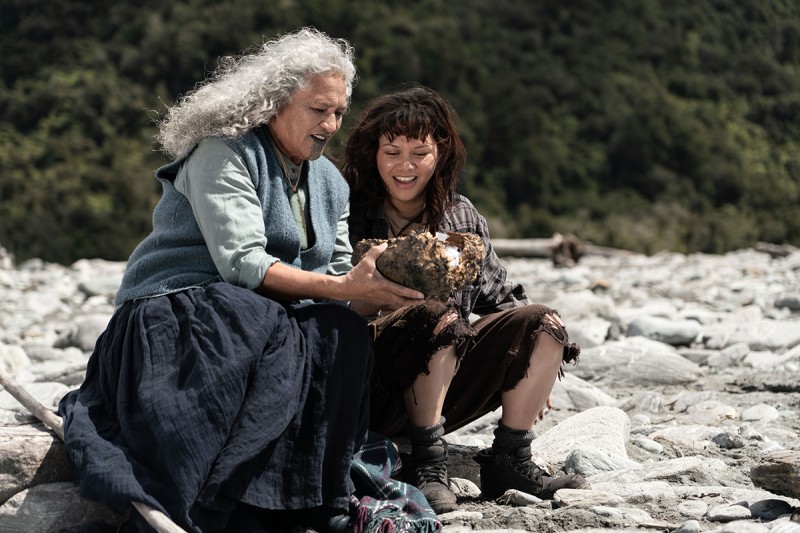
Still from Kōkā
Wellington Silver Screeners: Verity Mackintosh by Alessia Belsito-Riera
In our Wellington Silver Screeners series, Alessia Belsito-Riera shines a spotlight on the movers and shakers working in the film capital of New Zealand.
With her new film Kōkā having recently been released in cinemas just in time for Matariki, Wellington-based producer Verity Mackintosh is looking forward to hearing the conversations it will spark.
“It’s a beautiful film to just go to yourself, but you really want to go and see it twice and bring the entire whānau, because it’s an incredibly unifying and enriching film for everybody,” she says. “I’m so deeply proud of it.”
Kōka went to Māoriland Film Festival earlier in March and won the Tōtara – Best Drama award, followed by imagineNATIVE in June.
With decades of experience working in the film industry both here in Aotearoa and abroad in a huge range of roles, Verity has reached the conclusion that every country has its stories.
“It just depends on whether your eyes are open to see them and to see the benefit of them,” she says. “I’ve always grown up in a world where there’s more than one way to solve or to approach anything. Different cultures or different backgrounds, it didn’t matter, every way was valid, and I’ve learned a lot through that. It’s such an enriching and nourishing way to look at the world.”
Today, as a producer, she focuses on supporting deeply enriching narratives that celebrate Aotearoa. Kōkā stands as a testament to this vision. I sat down with her to discuss the story that makes her shine.
What sparked your interest in filmmaking and storytelling?
I was in high school, actually, and I really loved Judy Bailey [laughs]. I loved how welcomed to everyone’s living room that she was, and how dependable she was. So that sparked my interest in television and film. I started doing work in my teens on commercials and then I started TV school in Dunedin and working at What Now in Wellington, before it moved back down to Christchurch. After that I worked at Gibson Group in the camera department on The Insider’s Guide series, which I adored. Then I worked my way up from production assistant to producer with Sticky Pictures. We did The Living Room and The Gravy series, which were arts and culture shows. It was an amazing time; I was with them for about three years.
After that I did science and innovation and education work with CWA, and then I moved to Taiwan – my husband worked for Foreign Affairs and we were posted to Beijing, but part of that time meant that we had a couple of years in Taiwan. There I found aid programmes where I could help teach art and photography to children in the hill tribes that couldn’t make it down to the schools. We helped raise a lot of money to build a community centre so the children could go to a safe place and learn from their own community members. In Beijing I was working for Natural History New Zealand (NHNZ) as their lead producer in the Beijing office and I developed and created a number of series about China for foreign audiences. Whilst I was there – you know, when you’re away from home, you suddenly become extremely patriotic about home. At least I did, perhaps because of the circle that we were in for foreign affairs as well. It just further galvanized the fact that when I came home, I really wanted to make taonga for New Zealanders.
Was working in the Beijing film industry different from New Zealand’s?
Yeah, it was. It’s supercharged. Here in New Zealand, you might be able to do one or two big projects a year. There you’re doing multiple projects of that size almost every month. It’s quite a different industry: a completely different population base in terms of numbers, but also a different prospect for how to release.
What draws you to the role of producer?
It’s always been my goal to work in a producing role. I am deeply creative myself, but I have understood over the years that my creative propositions are things with a beautiful visual aesthetic and a really deep story but supporting others to tell that story.
A producer’s role is quite big, as you would expect. You’re sort of the head of the business arm, but you also communicate with the creative team to make sure that we have everything to create the film. So that goes from business to contracting to day-to-day scheduling and management. Obviously, that’s once you’re in production, but before that, it’s stakeholder engagement and fundraising and being a general cheerleader.
Where my role differs from other producers is that I am there from developing the script, right through financing, the whole way through production and post-production, all of the marketing and all of the release work. It’s because I’ve had so much experience across my entire career in each of those and I really enjoy every different aspect. My role is extremely varied. It’s such a funny term, the word producer, because it means nothing of note to people outside of the industry, because it really just doesn’t even encompass all of the aspects of that role. A vision or a script can’t really go anywhere without having a producer attached to it.
Tell me about your latest project Kōkā.
Kōkā is a Māori drama. It’s majority in te reo Māori, Ngati Poroutanga, which is the original dialect from Ngāti Porou. It’s a beautiful intergenerational story, which has a lot of beautiful values that I see in this world but would also like to really encourage more of. It’s about one woman’s journey home and how important it is to get there.
I met Kath Akuhata-Brown, the director, at the end of 2018. When I read the script, it was very special. I have stayed beside her since then trying to raise the support and the finance to help bring it to the screen. It’s not often someone is releasing their debut feature in their fifties and has chosen such a strong narrative. It really shows the determination that she’s had to lead with this film. It says a lot about Kath that this is the film she wanted to birth into the world first. From the outset I felt that she was a visionary, an orator.
Even though we’ve both had very long careers in television and various other things, in film, you have to cut your cloth to be recognised as a funding partner. So when I met Kath, we realised quite early on that to be eligible for feature funding, we needed to work together and make a couple of short films as well. So, we created Purea, which was initially a screen test that has travelled the world in its own right and has been to most of the Indigenous film festivals and at the Smithsonian. That’s a beautiful origin story for Kōkā. And then we went on to create Washday as well, which has had a whole festival life. These were all the stepping stones that we needed to work on together to galvanize our relationship for the industry to see.
I read that part of Kōkā was filmed in Wellington. How would you describe working in the capital’s film industry?
I try to bring all of my filming work here. I live here, I love the city, and there are so many extremely talented crew around. We have this wonderful industry here with great studios like Avalon and Lane Street and Stone Street, two of which we used. We really wanted to run the production out of here and support our local industry, which, at the time when we made this film, there was not a lot happening. The American strikes were on, so the entire production world just screeched to a halt. It was important for us to take that opportunity and run with it. Working in Wellington has been great. We love Screen Wellington. We filmed all over – pretty much the entire way around the coastline, in Porirua, in Upper Hutt – but we traversed most of the country from the West Coast of the South Island right up to the East Coast of the North. Moving over 100 people to do something like that is an enormous undertaking.
What advice would you give to somebody who wants to get into filmmaking?
Like with any job, always have an open heart and an open mind. This industry is so deeply fuelled and connected by the relationships that you make, so always be available to help. If a role comes up that isn’t exactly what you want, don’t turn it down. Get in there and show how much you really want to be in this industry, and it will look after you. But don’t lose sight of your vision.
What’s next?
I have a documentary that I’m about to release. I’m deeply proud of this one as well. The project is called Joy, Full & Fearless, and it’s a documentary about New Zealand author Joy Cowley, who, at 88, has never had a documentary made about her.
View more articles from:
« Issue 248, July 15, 2025