
Photo by Liv Pettitt
Wellington Silver Screeners: Tom Field by Alessia Belsito-Riera
In our Wellington Silver Screeners series, Alessia Belsito-Riera shines a spotlight on the movers and shakers working in the film capital of New Zealand.
Drawn to filmmaking from an early age due to its worldbuilding and complex characters, Wellington filmmaker Tom Field loves “that full immersion and escapism from what’s going on in normal life”.
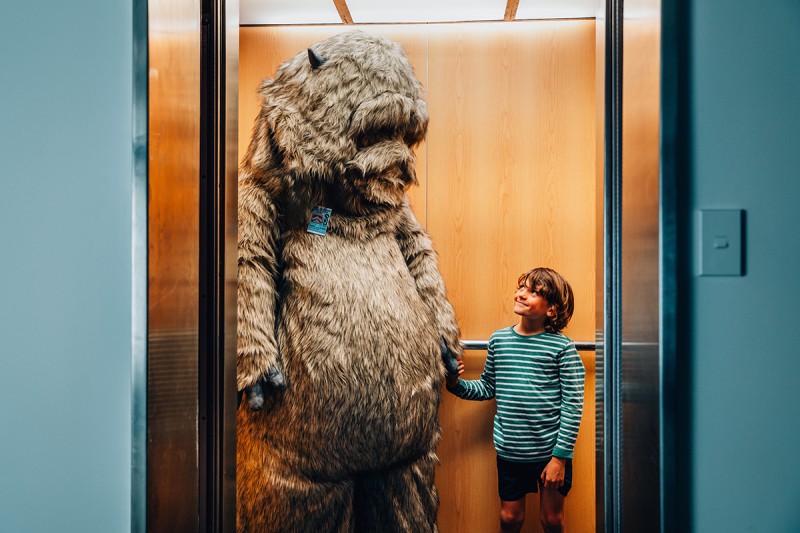
What began as a passion in school quickly grew into a university degree and blossomed into a full-blown career in the industry. Today, he works at Park Road Postproduction doing restoration work on old film, but that doesn’t mean Field doesn’t sow creative passion projects of his own, the most recent of which is the short film monster & me. Made as part of the 2025 Day One Shorts collection and having screened at the Show Me Shorts Film Festival, the project is now viewable on YouTube, RNZ, and MĀORI+.
But something tells me monster & me has a bit more screen time in store seeing as Field is currently working on expanding it into a feature film. The Welly creative tells me all about the process and his plans in the interview below.
What do you love about filmmaking?
How creative people can be in the medium and how it can be all tied together with music, sound, and acting. I didn’t really understand how movies were made as a kid and so I was like, ‘Oh, I think you have to be an actor’. I went into theatre and I hated the spotlight so much. Then I realised there was more behind the scenes.
Tell me about your career so far.
I started in school making short films on my own and with mates. One of the teachers put me onto a competition and it was my first exposure to film festivals and the opportunities that they can provide for people. I ended up winning it with my mates, which was really cool. It was at NZ On Screen. I went to university [at Te Herenga Waka – Victoria University of Wellington] and did the film production course, which was really good. I had some really awesome teachers like Paul Wolffram and Adam Brown and Bernard Blackburn. They were so encouraging and supportive. Even with the most recent thing that I’ve made, they helped. I found university quite good for just meeting likeminded people and being in the sphere of creating things. It was like a training ground for networking and building relationships in film. Then I went on to work for NZ On Screen for about a year doing video editing. That was like a small step into the industry and getting to see how it operated. It was good because it taught me a lot about the history of New Zealand film, which I felt was very valuable and still serves me today. After that, I did a tiny bit of freelancing, but I actually took a break from film and went and worked for an after-school care with neurodiverse and behaviourally challenged children as well as neurotypical kids. It was focused on integration and mentorship for those who needed it. I found taking a break and doing something different recharged me. It was a really good life experience to see how other people live and have it harder than I do. Now, I work at Park Road Postproduction doing restoration work on old film. It’s been really great to get my hands in some post-production stuff. I’ve always been really interested in editing, as well as directing but that’s not a very fruitful line of work; you have to grind constantly. From my experience, whether you’re young or old, it doesn’t really matter in the film industry, but people in more important jobs are 50s-plus, so I’m like, ‘I’ve got heaps of time to learn, so what’s the rush.’
What do you love about editing?
What I love and what I hate [laughs] is the freedom of choice. If it’s something that I’ve been on set for and am now editing, there’s massive satisfaction seeing it all laid out in front of you and going, ‘Oh my God, we did it. Now all I have to do is edit it. That’s easy’. It’s never that way, but it feels like you’re over the hump at that point. It’s here now, it’s materialised. I quite enjoy that you can really stretch your muscles. I feel like there are just so many different ways you can be creative with editing – whether that’s the conventional straight narrative story or whether you want to cut something really flashy, it just offers up so much creative thinking and problem solving as well. It is kind of like a puzzle. Like creative tinkering.
Can you tell me about some of your creative projects? I saw some of your short films went to festivals and did really well.
The first one that got me started was Big Kids. It’s documentary, which I’d never done before. For me, I need to motivate myself more to watch a documentary versus a fiction film. I like fictional worlds and stuff. So with Big Kids, it was quite a fun challenge to bring the fiction aspect to documentary and working out what story I was passionate about and how to tell it in a way that kept me interested. Once I found that, I loved the process and loved working with the people who I got to work with as well, particularly Dan, who was our subject. Once we’d crafted up that story, we put it through a few festivals, and it did well, which we were really pleased about. We went on to a few international film festivals, then New Zealand Youth Film Festival picked it up and gave us best documentary. So we were really pleased with the outcome, and it felt really nice to cover the topical issue of men’s mental health and New Zealand male culture, like not opening up and talking about feelings.
Something I co-wrote recently with Elora Battah, the producer of Big Kids, is monster & me. It’s about a big fluffy monster [Mot Mot] and his mundane, boring nine-to-five life getting flipped on its head by what he would probably think is an alien but actually is a human boy who arrives in the world and changes his life. It was quite a challenge to make that film because I was really keen to hone in on practical filmmaking and effects. The monster itself is a full creature costume with puppet mechanisms inside the head to allow for minute things like blinking. It goes a long way to add that sense of realism. The idea for that came from working in childcare. I was in a place where I was quite burnt out and planes were shifting, you know, jobs weren’t there for film and I was like, ‘Oh God, is this my career? Am I going to still do this?’ Working with those kids recharged me and showed me a different way of thinking. It was a really enlightening experience. If you take this story or this relationship between me and some of these kids and reskin it in a way that’s captivating, that’s where the idea for monster & me came from.
What content and themes are important to you?
I would say mental health is a big one that I have kept coming back to. I’ve felt recently, just with Big Kids and monster & me, and maybe it’s just the phase of life I’m in at the moment, but I don’t feel like telling stories that are dark and don’t have a nice outcome. We need a reality check with the world we’re in, but I’m also, like, ‘God, the world might just need a hopeful movie’. Films that show you can be kind to others. I’m still pretty keen to explore neurodiversity, highlighting the importance of that community and not feeling outcasted or othered.
How would you describe Wellington’s film industry?
It’s pretty small… and that’s a good thing! Everyone knows each other. It comes in really handy if you’re looking for crew because you’re so well connected. And, like, 99 percent of people are really supportive and encouraging. It’s astounded me the generosity that some of these big people have for young filmmakers.
What advice would you give someone who is just starting out?
Just meet people, but it’s hard. It’s an industry catered towards extroverts, I think. Find your niche, find what you’re really into, whether it be puppet-making or editing or sound design, and just keep practising, keep honing. And don’t be afraid to collaborate with other people, even if it’s in other industries. Any exposure is good and also sometimes not working in film might actually be quite helpful. You might learn something that you wouldn’t have learned in the industry. I wouldn’t have come up with the idea for monster & me if I had stayed working in film. We’re all very creative people that work in this industry and I don’t think there’s a strict linear pathway to follow – you just take it as it goes, you know?
What’s next?
This is the first time saying this out loud, but I’ve spent a while fleshing out monster & me into a feature script, which has been really challenging because I do not like writing at all, but I’ve been told that it’s not going to happen if I don’t do it. The short film was meant to be a teaser. It’s taking me a while, but I think I’m halfway through the first draft. When a story comes along that I’m keen to do, I would really love to shoot something on 16mm film and start moving away from digital. So to answer your question, just practising writing and seeing if anything comes up!
View more articles from:
« Issue 264, March 24, 2026