
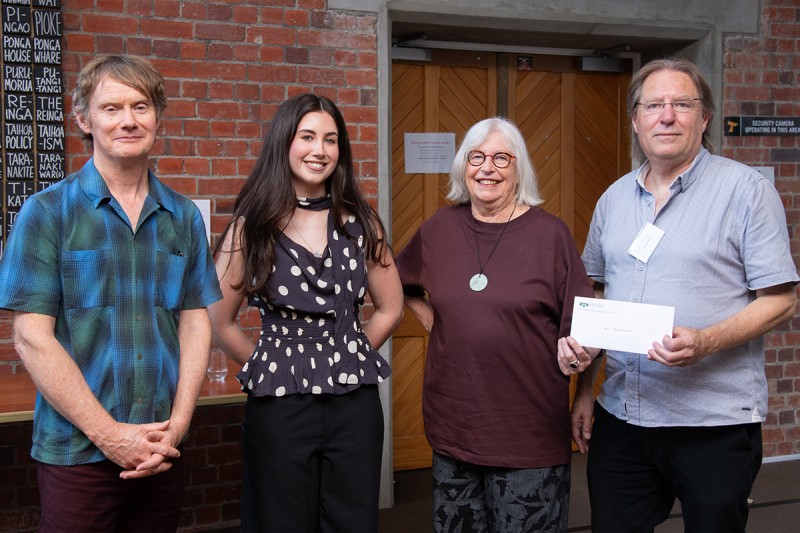
L-R: Damien Wilkins, Eva Brunel, Gaylene Preston, Ken Duncum.
Wellington Silver Screeners: Eva Brunel by Alessia Belsito-Riera
In our Wellington Silver Screeners series, Alessia Belsito-Riera shines a spotlight on the movers and shakers working in the film capital of New Zealand.
When she was younger, Eva Brunel loved making videos of everything.
“I would film myself baking or getting ready… and I loved editing. It made the most sense for me,” she reflects. “And I always loved writing.”
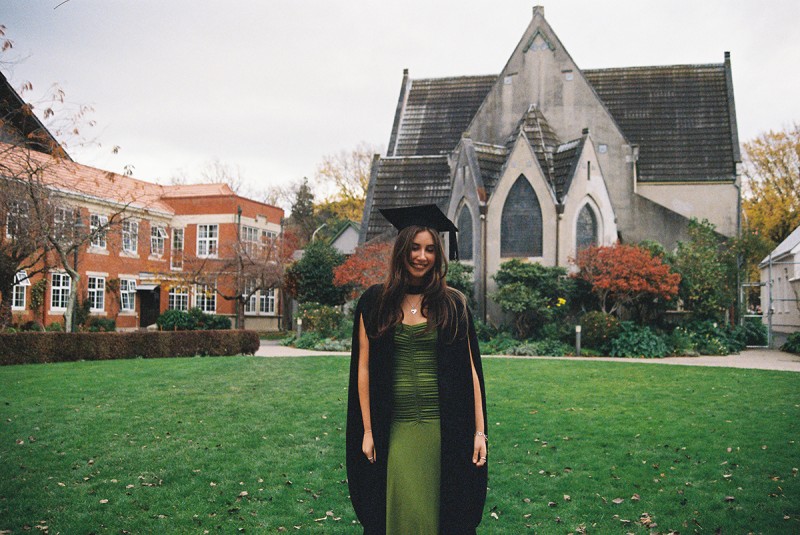
So upon graduation, she enrolled at University of Otago for her undergrad where she studied film theory and history before deciding to do her master’s in screenwriting at Te Herenga Waka – Victoria University of Wellington’s International Institute of Modern Letters (IIML). Here, she began writing a feature film exploring female friendship, which was recently awarded the 2025 David Carson-Parker Embassy Prize in Scriptwriting.
Described as a story that is “powerful, inventive, and original, combining psychological, romantic, and comedic genres with the occasional hint of horror”, Peephole is still evolving, but Brunel tells me all about it, her process, and her inspirations below.
What sparked your interest in filmmaking?
I’ve always really loved film and media. I enjoy the way a film will make you feel regardless of what’s going on. It’s a form of escapism, and there are certain stories that latch on to you. I’d love to be a part of and create some of those stories.
Was there a specific movie that made it click?
Titanic. It was the most insane thing I’d ever seen when I was, like, 12. I couldn’t believe that it was made – not much of it was actually filmed on a boat. That was my first unlocking moment where I was like, ‘Wow, you can really do so much with this artform’. Then as I got older, it was more sentimental films. The ones that transform the way you see things and change how you go about your day and that you continue to think about.
What content and themes are important for you?
I focus on female friendship. I think the time between 18 to 25 isn’t explored as in depth as it could be in film. I like smaller moments that are a bit more mundane but have so much meaning to them. I focus a lot on conversation, which, in screenwriting, is not actually ideal. You should technically be focusing on action and moving image – what you’re seeing. But I think it’s the moments that open up for conversation that are really special. I saw Past Lives and the whole film was quite silent, but there are three big conversations that happen that really grab you. It’s those things that I like to focus on.
Tell me about Peephole. What inspired the winning script?
It’s a thriller drama about a girl who lives with her friends, and she begins an affair with one of their boyfriends and they’re also being stalked by an anonymous figure. The initial inspiration for Peephole came after I met someone who used to live in my flat. She explained that they named it Peephole after they discovered someone had been cutting holes in their curtains. This is where the majority of the thriller inspiration comes from as well as the mystery aspect as to who is stalking the girls throughout the story.
It has transformed into different things over time, but initially I wanted to write a story about my experience flatting with my friends. I ended up in a flat of 10 people at one point, so it was very busy and there was a lot going on, yet we were all super close, which is rare. I knew I wanted to write it down, and that I needed to capture it and keep it safe in some way. But writing a screenplay with 10 main characters isn’t ideal, so I started with six and then went to five and then four. It’s an interesting story that traverses friendships, friend groups, loyalties, fear, and it has a couple of jump scares as well. It’s a mashup of everything that I enjoy the most in film. It’s all about being under pressure and how you behave when you’re always being watched.
What was your first reaction when you heard the news that you’d won?
I was so confused and shocked. I’m really grateful for it, but I just wasn’t expecting it. My class was full of so many talented writers, so it was a pleasant surprise.
What’s next for Peephole?
It’s still only on its third draft, so, ideally, I’d like to redevelop it more. I’d like to complete two more drafts before I would say it was anywhere near ready. Some films go through, like, 20 drafts before they get to shooting or even pre-production, so at the moment it’s just refining that story more and making it more impactful. I definitely want to do something with it. I don’t want it to sit on a shelf. Even though I do think screenwriting is an artform on its own and doesn’t need to be made to be complete.
What does the screenwriting process look like for you?
It seems massive when you sit down to a blank page and think ‘I’ve got to come out with between 90 to 120 pages’. But I was mentored by Ken Duncum [at Victoria University] this past year and his teaching was incredible. The easiest way to do it is to try and not flesh out your whole story before you begin. You’ll find that you get to know your characters and they’ll do their own thing, regardless of you controlling them. Have a basic outline of three acts – where you want it to start, a middle point, and an end – and just go five pages at a time. Truly, it will write itself. You’ll be really surprised at how the story will take shape on its own. You’ll have an idea or see images of things happening and then figure out where in the script that would fit. Don’t rewrite anything until you have finished the whole first draft. I don’t even read back what I’ve written until I’ve done the whole draft because you’ll get in this constant rewriting loop where one page is not good enough and you have to rewrite it and make it perfect before you move on, but you’re not going to the end product without letting yourself write. Revising and drafting, that’s what it’s for. Don’t be afraid to let the story take its own shape. You can always change it; it’s just words on a page, but if you don’t let it happen in the first place, then you can’t fine tune it.
You said you enjoy editing as well. How do those interests intersect?
I think editing videos and editing writing is very different, but in a way, it’s not. You’re just cutting and pasting, really. I enjoyed going back and editing my script more than I thought I would. I’m not the best proofreader, but I’ve definitely learned how to do it much more this year. I think it’s just about picking little things to focus on that makes the editing process easier. Sometimes I’ll do a pass just for grammar or spelling, and then sometimes I’ll do a pass for dialogue that I think isn’t good or precise enough, or ways I can re-order scenes, which is really fun. But it’s very different to editing video because that’s so much more of a visual medium. With what you see you can convey so much, whereas with writing, you have to really set the scene. Editing out action is a lot harder than editing out dialogue.
If Peephole became a feature, would you direct it?
Oh, I would love to direct. It’s always been a big dream of mine. I’m not sure how experienced I would be on something like a feature film, but I’ve directed short films on my own before. I think I would be really scared about handing it to someone else, but with the right director that I could trust, I would definitely hand it over. Especially if it meant that it would become something. I would love to direct it, but I’m not sure if I’m the best person for it, to be honest, at this moment in time.
What advice would you give someone who is just starting out?
Letting inspiration come from your daily life is really nice, letting your imagination run. And consuming media in short bursts. See what kind of opportunities are out there for you. Wellington is so amazing for film. There are many amazing companies and production studios that are so underrated. There are so many opportunities out there. Make things that you’re not proud of because it’s just a learning experience and it doesn’t matter, really. If it’s not going anywhere, then it’s just a learning experience. That would be my biggest advice: not to be afraid to just do it, just write the screenplay. No one’s going to see it if you don’t like it, and it just gives you your first draft to revise. Just go for it. Don’t be concerned about whether or not it’s an artistic masterpiece if it makes you happy.
What’s next?
The next draft! I really want to focus on getting, hopefully, two more drafts out this year. Just ready for what the future could be. I’ve been studying for a really long time, so I’m excited to not be anymore. Not because I didn’t like it, just because I’m ready for a break. So just focusing on those drafts at the moment and seeing what opportunities are out there. There are so many amazing fellowships and screenwriting residencies that I’d be really interested in.
View more articles from:
« Issue 263, March 10, 2026