
Through the window by Isabella Smith
Music and the Mystical Experience had its world premiere up in Tāmaki Makaurau earlier this month as part of the 2026 Doc Edge Festival. The film follows sound engineer and psychedelic music reasearcher Michael Sutherland alongside 28 musicians as they create a six-hour long improvisation album designed to accompany psychedelic therapy sessions. Featuring interviews with artists, studio footage, and shots taken on the coast and in the hills around Pōneke, Music and the Mystical Experience is both an exploration of the unique creative process that went into making the album as well as a showcase of the importance of music in psychedelic therapy.
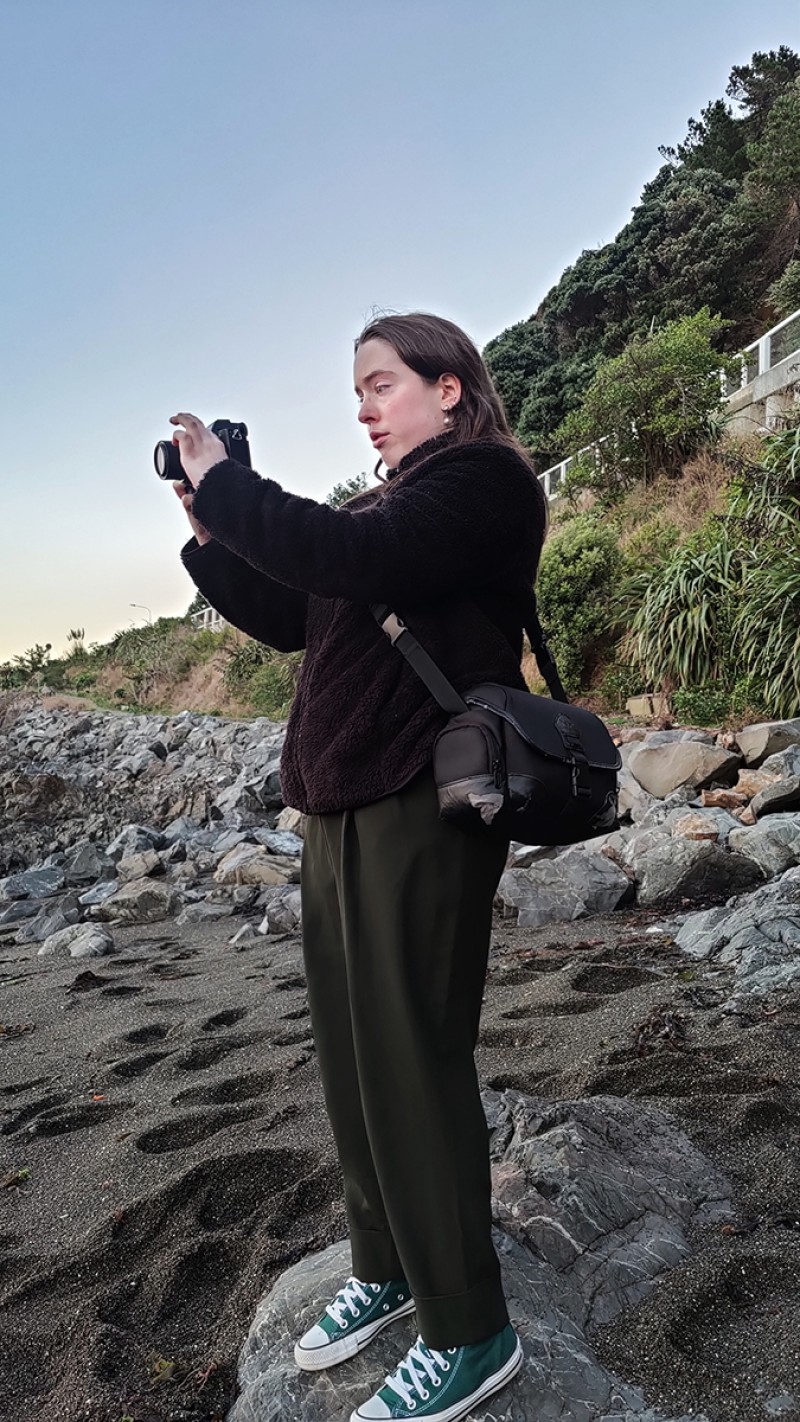
I caught up with Isabel Corfiatis – filmographer, director, editor, and many things in between – to discuss the film ahead of its screening on Saturday the 18th of July at Roxy Cinema as part of the Doc Edge Festival.
How did you end up on the team, were you along for the whole journey?
Michael asked if I wanted to help him make a documentary and I jumped at the chance. It’s something I’d been wanting to do for a long time. It’s such a cool subject to do it on as well. The only issue was that the music had already been recorded. There was no footage. At the time, Michael didn’t know he wanted to make a documentary – he didn’t want any distractions in the recording studio, no phones, no nothing. Luckily, he ended up recording a second album. We got the footage of that being made, which explained quite well how the first one was made.
You had a lot of roles during the making of the film. How did you manage putting on all the hats?
It didn’t feel like there was a huge amount of pressure. It wasn’t as stressful as it is with a scripted film. At the same time, it’s a lot of work when you’re a team of two or three doing everything. But it also means you have quite a bit of control. Everyone did as much as they could with everything they could. We all worked cohesively as a team, which was nice.
What was it like translating all the footage into a cohesive story?
It was really difficult. I’d never made a documentary before, let alone a feature. I didn’t realise how much of the writing is done in the editing room. We didn’t really have a plan. We had scenes we wanted to get during the recording, but we didn’t have anything written out. It was all about showing up and seeing what happened. Afterwards we had hours of footage and were like, ‘Oh, we have to stitch this all together now, we have to make a story here.’ Obviously, there was a story before we started, but we needed to make everything fit in a way that makes sense and to put a visual spin on things. It took a long time. It was a huge challenge. I think we ended up with something that feels really true to us and true to what Michael’s trying to show as well.
Does the film raise awareness for music within psychedelic therapy?
Before making this film, I’d never heard of any of the stuff that Michael’s doing before. It’s really unique. Michael explains a lot about it in the film. There’s definitely an emphasis on raising awareness about how important this part of psychedelic therapy is. That without the music you don’t have a proper therapy setting. It’s incredibly important. If you use the wrong music, it can produce a completely different atmosphere. It’s something that Michael wants people to think seriously about when they’re doing psychedelic therapy. I can see how passionate he is, and it comes through in the film. It’s really cool to see how passionate all the musicians are about the album too.
What is it about the documentary format that interests you?
I grew up watching a lot of documentaries and a lot of films in general. There’s something about getting to look through a window into people’s lives, especially when they’re doing something that’s interesting and that they’re passionate about. You get to be a fly on the wall. Documentary is a very people-oriented format. It’s so special to see people in their natural environment doing their thing. It’s something you can’t really get in scripted film. In a documentary, you can’t predict what's going to happen. You can’t predict what the subject is going to do, and every time they will surprise you. As long as the camera is rolling, you go with the flow, take your hat off a minute, and let everyone else lead you.
What sparked your interest in film?
I started making videos when I was a kid, at the age of nine or so. I always had other career options in mind. All these random, very different things. But I was always making films. I was always behind the camera, writing something, doing something. I would rope my friends in and get them to hold the camera or act in the movie. It was only after high school that I was like, ‘Wait, this is what I'm supposed to do, this is the only thing I really love to do.’ It’s the only thing I can’t not do. I can’t stop thinking about making films. That part of my brain doesn't switch off. I think deep down I’ve always known I never really wanted to do anything else.
What’s your happy place: being director, script writer, all of the above?
Each one is so different. Writing a film, when you’re in the flow of it, is really exciting and fun, and you get to build it in your own time. But then when you’re on set directing, it’s an amazing feeling, you’re so focused and in the moment. You’re making all these bits and pieces come together. Every role offers something different. I love them almost equally. If I had to pick, possibly directing, but again it would depend on the project and the day.
In the film industry, the hierarchies aren’t really conducive to straddling multiple roles. Is grassroots an important aspect for you?
Yeah, definitely. The only thing that makes that hard is getting funding to actually make films. In the future, I want to have projects where people can earn a living. But I think it’s important to be able to start from the ground up and have everyone who’s at a similar level come together and be like, ‘Yeah, let's make this thing.’ Because you’re all passionate about it, you want to succeed no matter what it takes – even if it means you don't make money for a while. You can do things without a lot of money up to a certain point, but funding is needed for films.
It’s been a start from nothing and build it up situation. We’re in the building up phase now, and I’m really enjoying it – I can see it taking off. It’s quite exciting. There are a lot of people who’ve helped me along the way, a heck of a lot. I’m very grateful for everyone.
What’s next for you?
We finished a short film a little while ago, which is now in the process of being entered into festivals. Then I’ve recently written a feature script which I’m keen to make – that’s the next project. I can’t wait to get it going. In the future, more documentaries, more scripted features. Just keep going. Because as soon as you make one thing, you immediately start thinking about the next one.
View more articles from:
« Issue 272, July 14, 2026