

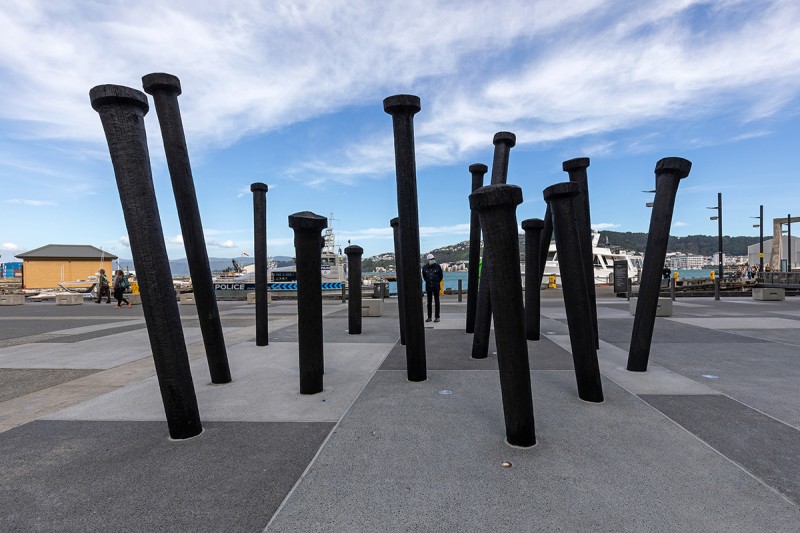
Photo courtesy of Wellington Sculpture Trust
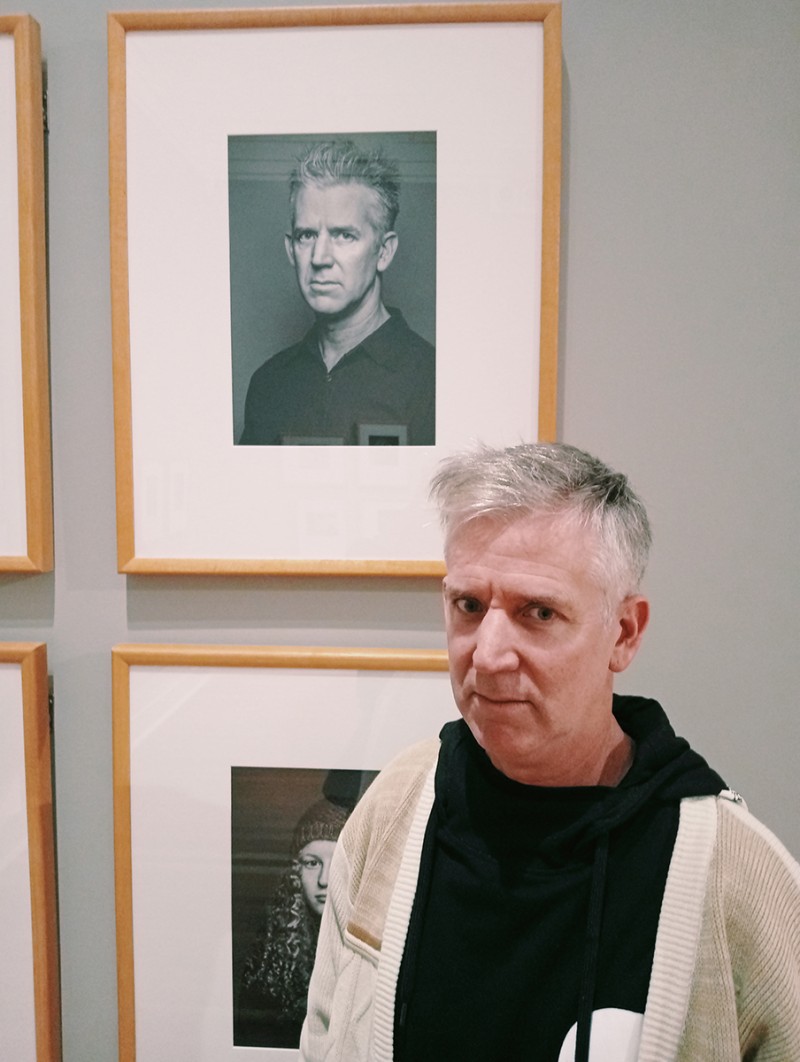
Glen Hayward
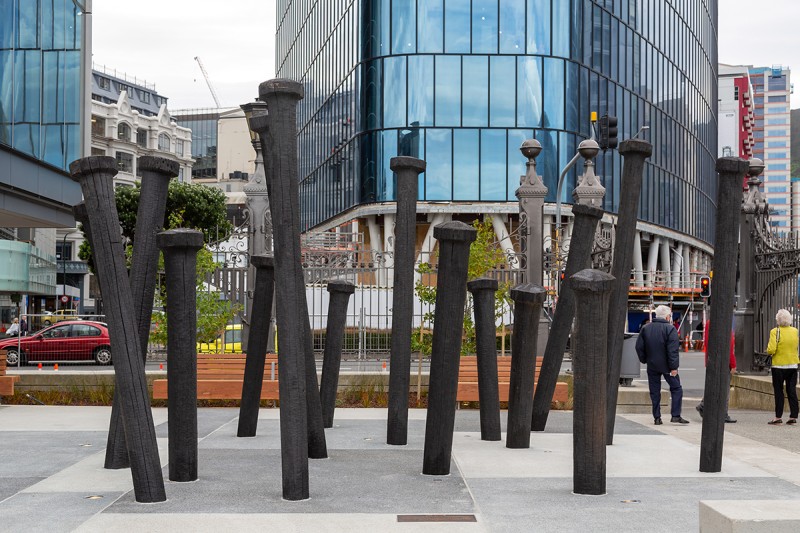
Photo courtesy of Wellington Sculpture Trust
The Grove by Isabella Smith
In this new series, Isabella Smith talks to the artists behind the sculptures dotted around our city.
In 1849, The Inconstant foundered at the entrance to the Wellington harbour. For £80, British entrepreneur John Plimmer salvaged and moved the ship to his jetty on the shores of Lambton Quay – in front of what is now Plimmer Steps – and used it as a warehouse known as Plimmer’s Ark. The 1855 earthquake lifted the shoreline and tipped the ship over, rendering it unusable. With land reclamation efforts it was eventually buried, until 1997, when the wooden remains of the hull were unearthed beneath the Old Bank Arcade during renovations. Fast forward 20 years and the Wellington Sculpture Trust were donated some of the remaining timbers for the use in commissioning a sculpture.
While the original wood was too damaged to incorporate, Whanganui-based artist and sculptor Glen Hayward looked over the timbers and noticed bent nails sticking out of the wood. He became interested in the significance of the nails in the structural integrity of The Inconstant and Plimmer’s Ark and as markers of tension within the joinery of the timber. Looking at archival photographs of the excavated remains, he noted the way the upright ribs of the wood sticking up out of the ground mirrored the boat’s shipwreck origins.
The Grove, installed in 2022 within the waterfront’s Whitmore Plaza, is a collection of 16 copper-headed nails of varying heights. Like a palimpsest with older layers of text still visible beneath the new text, if you peel back the layers of The Grove, you find residues of the past. Modelled on the nails found sticking out of Plimmer’s Ark, the sculpture not only honours Wellington’s maritime history, but tells a story of endurance. “The standing nails, though brand new, harken to something older, something left behind. A past that sits in the present like a memory”, Glen says.
In Glen’s work, “things are always standing in for something else”. Often described as an illusionist, he has exhibited extensively in Australasia, sculpting replicas of everyday items in wood. “I think this has something to do with the way that appearance is always deceptive. And yet appearance is the only way that we can access some version of, I won't say truth, but something that resonates more deeply than just a surface libidinal investment.”
There is a porousness in the way Glen works. His stepdaughter calls it angel numbers, Carl Jung called it synchronicity. Glen describes it as a kind of passivity: being “passive enough to be receptive to the things that are going to be possibly interesting.” To be receptive to fortuity or chance, there is a certain amount of distancing required to glean messages from events. Glen was walking along the Whanganui River and saw an old jetty, with old wooden poles sticking up out of the water reminiscent of the ribs of Plimmer’s Ark. “There was something about the endurance of this material with all the currents and winds.”
Later, when walking the beach of Castlecliff he came across tall wharf poles that had been removed from the Wellington Waterfront by a demolition crew and brought up to Whanganui. “Often, I find that when I’m actively trying to do something, it ends up being the worst way to get a good solution. In terms of navigation, if I psychically sit back from something, then whatever the solutions to the problems I am stuck on start to appear.” Discovering the wood was the sort of uncanny experience that is hard to ignore.
The wharf poles initially came from trees felled and shaped in Australia before they were shipped to Wellington. “I am often working with these residues”, Glen says. “You have to see spirit as still somehow residing, reinscribed in our chopping boards and in our architecture.”
Glen talks about carving as an archaic process, a form of proto writing that was first used on clay tablets as records of goods. “Carving is the verb form of sculpture”, he says. It moves away from the cultural propulsion toward excess and instead creates something positive through the act of removal.
The wood needed to be treated to endure the harsh weather and saline air on the waterfront. Glen employed the traditional, centuries-old Japanese wood preservation technique shou sugi ban where the timber is charred consistently at a very high temperature. The resulting carbon layer gives the wood its distinctive black colouring, while at the same time creating a barrier that naturally seals the wood and protects it from rot and decay. “What I love about the sugi ban method is that in some way you're using a weathering system to protect something,” Glen says. “It has this quality of removing material from the world to make the world present. It’s pre-emptively destroying in order to protect.”
Glen is currently working on a project for Sculpture on the Gulf on Waiheke. He is constantly interrogating his own thought processes and the ways in which he engages with his art practice and his sense of self and place.
“Public space is where you don’t have a community. In a way, it’s where you are rubbing up against people who not only do you disagree with, but you disagree about what the disagreement is.” For Glen, public art is a way of engaging and dealing with these spaces. The sculptures become participatory, a site of phenomenological encounter. “I want to be part of something, but I don't want to dominate it. I like the idea that someone might rest their back against a sculpture while reading a book. The Grove is not really a space where we do that because it’s quite open. But I love watching people walk through it. There’s a story we’re telling whenever we’re moving about in space, and sculpture gets to participate in this.”
View more articles from:
« Issue 272, July 14, 2026