
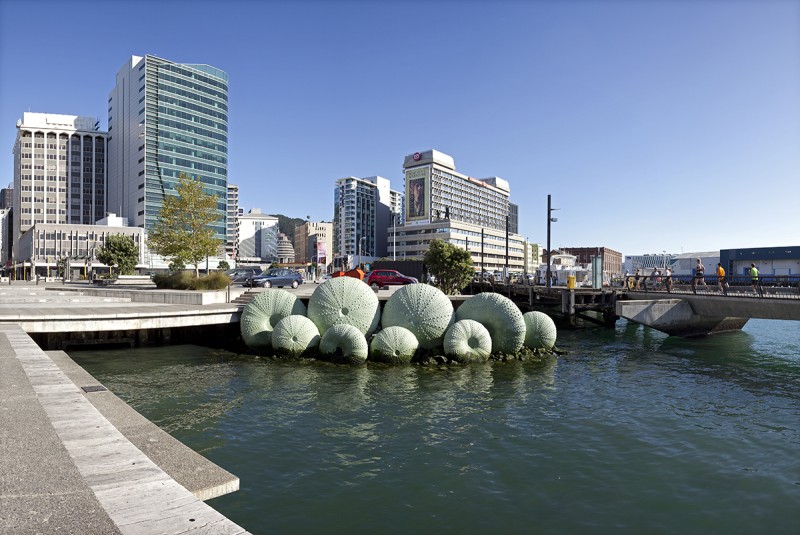
Photo by Shaun Waugh, courtesy of the Wellington Sculpture Trust
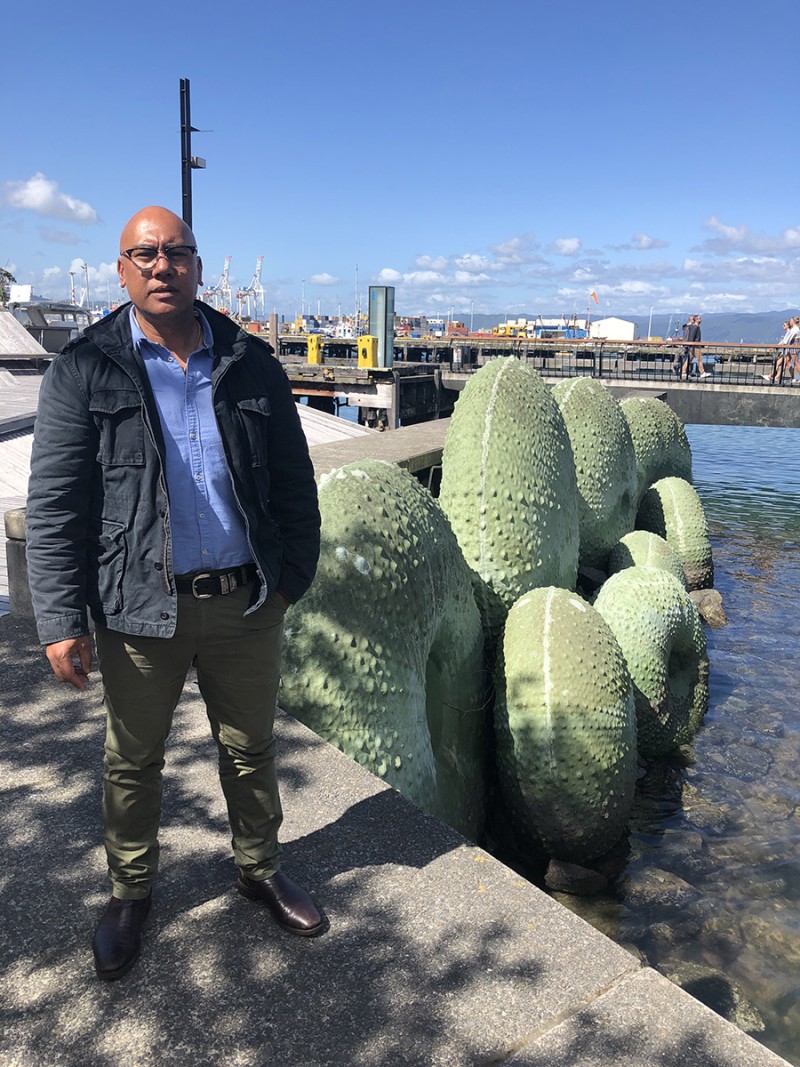
Michel Tuffery MNZM beside Ngā Kina.
Ngā Kina by Isabella Smith
In this new series, Isabella Smith talks to the artists behind the sculptures dotted around our city.
Sāmoan, Rarotongan, Mā’ohi Tahitian artist and sculptor Michel Tuffery MNZM has an expansive way of thinking. His sculpture Ngā Kina, found on the Wellington waterfront where the Kumutoto Stream – culverted in the 1880s to make way for city development – meets the harbour, is an embodiment of the scale at which he creates, interacts with the world, and perceives time, history, people, and our relationship with te taiao (the natural world).
The sculpture is made up of nine concrete kina of varying sizes, the largest of them weighing over seven tonnes. Resting against the seawall and submerged in the water at changeable depths depending on the tides, they are a reminder of the once active pā that stood on the shore beside the stream and can be interpreted as a midden: a shell mound where scraps were once deposited.
For years the site was a parking lot, transformed in 2008 into an architecturally designed public space honouring the ancient stream and pā. These days, the space is occupied every lunch time with workers of every stripe spread out on steps and benches taking time out to sun themselves and sit by the water. “But I was watching the amount of rubbish in the area and seeing people smoking their cigs and I thought, ‘Right, I need to make a statement because there are a lot of blue penguins there,’” Michel says.
An avid freediver in his spare time, Michel has scoured every nook and cranny of the South Coast and harbour since he was a young boy. Diving is “like going for a walk, but it’s the opposite”, he says. “Sometimes I don’t catch anything, because I hardly ever spear. I'm more interested in just looking at stuff. It's like a library, and that's the privilege we're being given, especially in our harbour and out on the South Coast. Regardless of what it throws at us, we're so lucky.”
His familiarity with the currents, tides, kelp, nudibranchs, and migration of marine animals as the seasons change reflects the sense of interconnectivity and responsibility he feels toward the environment and the protection of it.
“As a human, you start to understand all the cycles. I know those seasons and what is coming into the harbour. I wasn't surprised when the whale turned up the other day. It's usually about now, just after Matariki."
Over the last decade, Ngā Kina has become indivisible from its marine environment. Kororā (little blue penguins) have made it their home, seals have parked up to sunbathe, pāua, kelp, and microalgae grow between the cracks, and stratified tidelines document where the waters come up to and how much they recede. Sting rays perform their annual circuit, arriving in October and sticking around until March. The lights that illuminate the kina at night encourage fish to swim near the surface of the glowing waters. At times, large clusters of actual kina grow there, a sure sign of overfishing.
Ngā Kina took nine years to complete, with the initial idea seeded on a plane as it descended into Te Whanganui-a-Tara from the east. Michel looked down at the mess of demolition debris below and envisaged the sea wall lined with giant kina to be viewed from up high in the air. With the commission from the Wellington Sculpture Trust, the project was shifted to the waterfront. He undertook in-depth research into the site, interviewing mana whenua, and applied his knowledge of the tides and seabed to the schematic drawings.
Michel initially wanted 13 kina, with hints of them cropping up on benches and behaving like a trail to lead people to the edge of the water and urge them to look down, where they’d see the kina disappearing along the natural slope of the seabed and out into the harbour. This would remind them of the “synergy going on between the moana and the land.”
“I knew I was pushing it, but that's just me. That's the role of the artist. We're supposed to cause a little bit of disruption, get everyone's attention.”
With many roadblocks, hard conversations, and eventual compromises made with various architects, engineers, and waterfront governance bodies, they arrived at the agreed composition of nine kina, which were installed in 2012.
Ngā Kina marked a first foray into using industrial technologies to produce art at scale. Working with Tāmaki Makaurau company GRC New Zealand, the kina were sculpted out of fibreglass reinforced concreted using a five-axis CNC router – the precision technology used by the America’s Cup team to construct their foils – to scale up, carve, cut, and shape the concrete composite into the exact dimensions and detail (down to the millimetre) of a real kina shell. The giant kina were then transported on the back of several trucks down to Wellington and installed using cranes.
“I was pushing a lot of technology at that time. That's just me being a nerd”, Michel says. “I wanted to learn something new and use something that nobody's using. I put that down to a word I like to use: curiosity.”
He reflects on this building process as an extension of the ongoing narrative of the site: the mouth and banks of the Kumutoto Stream being an area full of activity, where mana whenua harvested harakeke and traded the fibres with other iwi and early European merchant ships.
An environmentalist and conservationist, Michel has been an active member of a number of environmentalist groups, including the group that won the court case to prevent the building of an aquarium at Te Raekaihau Point. “We don’t need any more human visual pollution”, he says. “This is what I love about being an environmentalist, we're only here on a short visit. We have a responsibility for the environment, and we’ve got to think ahead.”
“Living in Te Whanganui-a-Tara, we just get it”, Michel says, when we move to discuss Wellingtonians’ unique relationship with te taiao: the marine and bird life, winds, earthquakes, storms, floods. “Remember when the first whale came? They postponed the fireworks because of it, and no one complained.”
Michel still feels responsible for the maintenance of the sculpture. He tells me he regularly visits Ngā Kina and keeps an updated archive of photos to monitor the behaviour of the composite and track its degradation. The kina are showing natural signs of wear, “but that's just part of it, you know – I'm not here to fight the environment, we're just trying to figure out ways to work with it.”
“But it does need some attention. We don’t want it degrading so far that it plays into the midden narrative where it breaks apart and becomes a part of the sea,” he laughs.
“I think [Ngā Kina] has done what I thought it was going to do, though. It's left a residue.”
View more articles from:
« Issue 275, August 24, 2026