

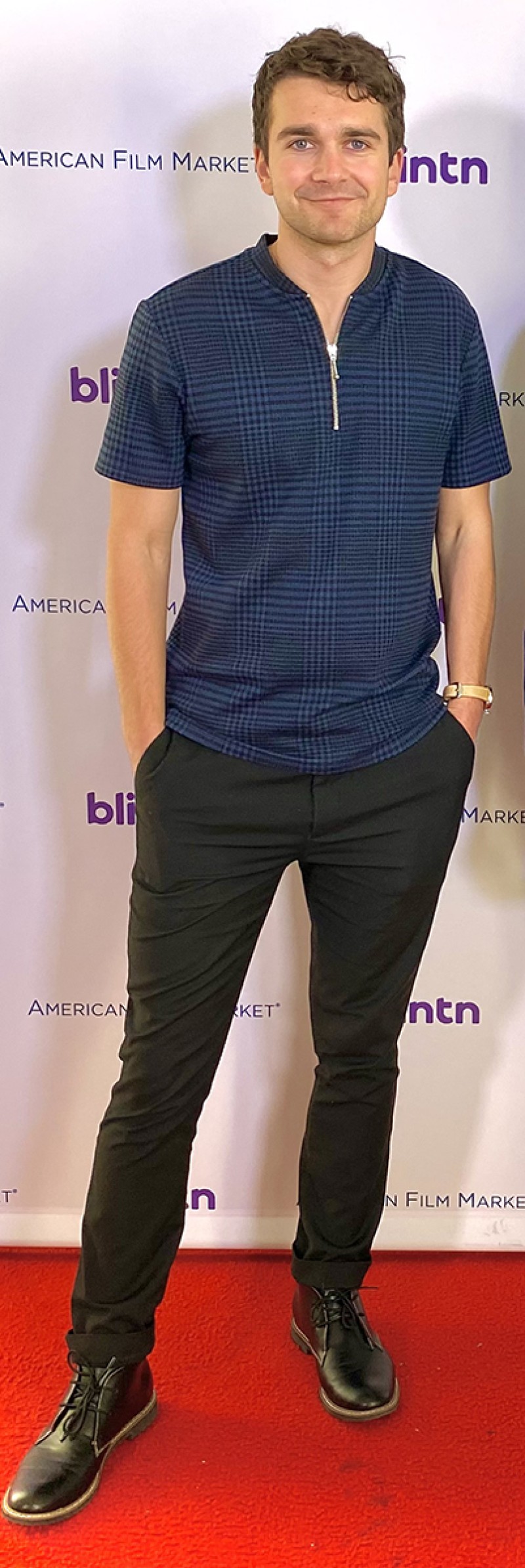
It wasn’t the fish by Isabella Smith
Ryan Matthews, a 28-year-old from Kāpiti Coast, started out his career in the film industry as a dishy. Five years later, he’s an executive producer of By Any Means, a Hollywood blockbuster starring Mark Wahlberg and Yahya Abdul-Mateen II which opened in nearly 3,000 cinemas across the US before making its international run.
Now based in Sydney with a plethora of other film projects in the pipeline as well as an internationally successful matcha tea company, we caught up to discuss how he carved out a space for himself in Hollywood by thinking outside the box and finding a niche.
Have you always been interested in film?
What drove a lot of my interest was learning about how the industry scaled, especially in North America, with Hollywood being such an export of film and TV. When I was in Vancouver at the University of British Columbia studying media, I witnessed a lot of production. I ended up spending the summers there and working on set as a production’s assistant for a big budget TV show called The Magicians. I was on set washing dishes and doing the dirty work. And these are long days. You’d be the first on and the last to leave. I remember being there for 15, 16 hours. But it was those early days that allowed me to understand how it all works. How a production happens, especially at scale.
Seeing the size of some of these sets in comparison to a couple of years later, when I was working in New Zealand for The Brokenwood Mysteries – a much smaller scale production – that really showed me the two ends of what film can be. I thought, ‘Okay, there’s obviously a difference in how these productions are financed.’
Films in America have fundamentally so much more money.
That was what stood out to me. In New Zealand, film is often financed more so through grants or what we call soft money, like tax incentives. Whereas in the US, you have financiers take on greater equity investments. There’s a real business behind it.
Initially, I was more creative and wanted to write and direct, but I realised being creative in that industry was going to be very difficult, so I went to the opposite side: the commercial side.
I began to think about how I could add value. As a 20-year-old from New Zealand, it’s very hard to go into a room full of executives and persuade them you have value that they can’t replicate. I always refer back to that quote, ‘We don’t know who discovered the ocean, but we know it wasn’t the fish.’ For me, being an outsider, I thought that could give me an edge. I wanted to really niche into one of the main difficulties in the industry, which is bringing on financing.
Going from a creative approach to getting clued up about finance must’ve been a big jump.
It was, but it took a long time. After Vancouver, during COVID, I moved back to New Zealand. I worked for Rena Owen, one of New Zealand’s most acclaimed actresses. A lot of the work that I did for her was admin related, but she showed me what being in a show as a season regular looked like, and I got to go on set.
It’s definitely true that it’s about who you know in film. Someone always gives someone else a helping hand to evolve and learn, and that gets forwarded on over time. Rena helped me when I moved back and was in limbo about what I wanted to do. At that point, I didn’t really have much awareness about equity investment in film, but I was definitely thinking, how do I create disruption in a very traditional industry?
I looked at a few things. One was importing the first technocrane – a very complex filming rig – into New Zealand, but there’s not a huge degree of need for it. Then I looked into virtual production. But the third thing, which became integral, was licensing film posters and selling them as digital assets. I licensed a poster for one of the most iconic games to movie franchises, Resident Evil: Welcome to Raccoon City.
Because I offered a creative way to add an ancillary revenue to film, suddenly everyone in town wanted to talk. Over several months I had over 300 calls with some of the most respected and influential producers in town. That was a unique moment where I realised I had access, that I’d cut through.
Obviously, once the market corrected in terms of the NFT downturn I thought, ‘Well, I’ve got quite an impressive and well-connected network here.’ The conversations then shifted from licensing posters to what’s your next problem, which was financing.
Sounds like it snowballed pretty quickly?
Yeah, that’s over the space of three or four years. When you think of most people, they don’t go from being an assistant to an executive producer of a big budget film in that time. The industry is very traditional; the average producer is much older than I am.
What was that like, working on By Any Means?
Because it was an independently financed film, I was able to be relevant to it by bringing on investment. It was later acquired by Paramount Pictures, but if it had been a studio film from day one, they would have built the project from development through to distribution, and they would own that capital investment. I was very interested in the film because it’s based on a true story and has an element of thrill, but most importantly because of the collateral that was already in place in the cast and presales.
It’s been a really cool project to be involved with. I intentionally didn’t read the script or watch the cut until I was at the Paramount lot for the premiere, which was special. It was a pinch-me moment looking back, to go from washing dishes to being at a premiere at Paramount.
What else is in the pipeline?
Yeah, there’s quite an exciting slate for me and my business partner Scott Cohen. We’ve got a film called White, a small-budget film with Kate Beckinsale leading it, as well as Slime, an animation featuring the voices of Kid Cudi, Teyana Taylor, and LaKeith Stanfield.
I’m also producing a couple of films with Unified Pictures: The Ark and the Aardvark with Miles Teller and Aubrey Plaza doing voices, and one called The Smack with Casey Affleck and Sam Rockwell.
I can’t believe you have another full-time job on top of that!
To be honest, the last four or five years, I haven’t really done much else apart from build both the film and the tea. It’s been a lot of work. But when you see the growth that we’ve had on both sides, it shows you that it’s worth it.
That’s partly why I wanted to reach out. If someone does read this article and they’re a young kid who wants to be a producer or an actor, I want them to know they don’t have to be related to a star or have the last name or have money or even be in LA. I had none of those things, but I found a way to make it happen. It’s incredibly difficult, but not impossible.
New Zealand has a tiny market of five million people, and it’s hard to create. Let’s say you make a movie for a budget of $10 million, you have a small fraction of the country watch it for $20, the theatres take half, plus you’ve got a prints and advertising budget on top of the production budget – that commercial equation is very difficult. Making a film in New Zealand for New Zealanders, that’s expensive, it doesn’t scale.
But in saying that, I don’t think that New Zealand films have to stay there. I’m quite bullish on the New Zealand film economy; there’s a real upswing because we have a really great way of telling good stories. It comes naturally to Kiwis, and I think we export comedy quite well. It’s extremely doable, now more than ever. The fact that you can find someone’s phone number or email – if you have the right pitch, the right leverage, and the understanding of what value you can provide, you can get a response.
Are there plans to use your skills to uplift the film industry in Aotearoa?
If there’s anyone out there that wants to learn, I’m always happy to help. Like I said before, there are people who’ve helped me a lot; I’ve learned a lot from my mentors. Still, there’s a lot I've got to do and learn. But there’s always that interest in supporting young New Zealand filmmakers and helping them turn their dreams into reality.
View more articles from:
« Issue 281, November 17, 2026