

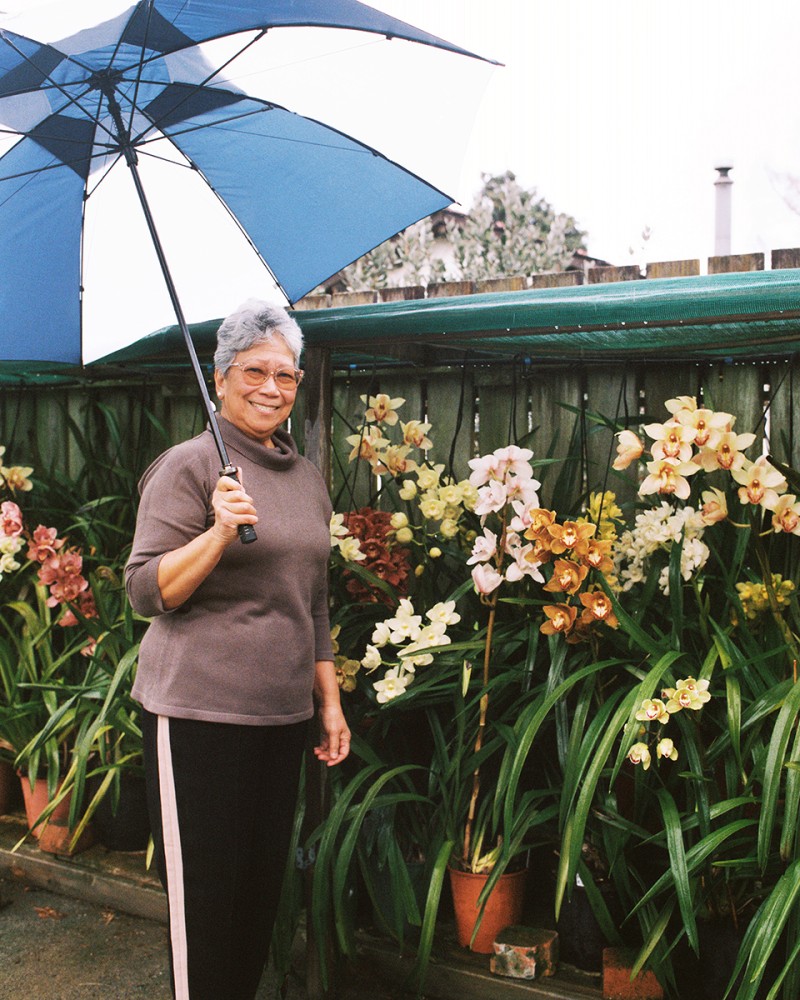
Editha, 2025
In their gardens by Isabella Smith
In one photo, Editha smiles at the camera, the white of her umbrella disappearing into the sky as she stands beside a multicoloured row of orchids. In another, Elizabeth stands on her concrete driveway looking at the camera over her shoulder, upon which she balances an enormous, curved, pale green tromboncino.
Kababayan translates to ‘fellow countrymen’ in Tagalog. A familiar term, it recognises a person who lives in the same town and comes from the same country. In 1986, Abigail Legg’s mother Elizabeth was the fifth Filipino to move to Feilding, Manawatū. Since then a growing Filipino diaspora community has flourished, gathering together to continue traditions from their culture, bringing home a little closer.
In this photography exhibition curated by Russell Kleyn, on at Twentysix Gallery until the 6th of June, Abigail has captured portraits of her titas (aunties) in their gardens in Feilding, offering a glimpse of their daily lives. In an Aotearoa climate, these women have cultivated Philippine flora, like ampalaya (bitter melon), sitaw (string beans), and orchids. Caring for the whenua they stand on, and building greenhouses that allow these plants to survive, these photos are celebrations that tell a story of endurance.
The women are often caught mid-laughter, eyes twinkling. Despite the cool tones, the greens of the gardens are almost irredescent. “I look for colours”, Abigail says. “Composition is always important too. I try and seek out something that may be out of the ordinary. In this location of work, the garden means we can play around with many backdrops and add different components. Shooting with a medium format film camera slows down my process and I am restricted to the roll of film that is loaded in there.”
After attending a lecture on Through the Shaded Glass: Women and Photography in Aotearoa New Zealand 1860-1960 by Lissa Mitchell, Abigail thought about her own bi-cultural experience in Aotearoa, and the difficulties in finding resources that reflected them. “From there I started to photograph those who I consider family”, she says, setting up photoshoots at their houses when visiting. “I have always imagined these photographs shown in the form of an exhibition. Large photographs of my aunties taking up space in a room that they wouldn’t typically. As a way to honour them and show respect to my elders.”
“My pamiliya (whānau) are a strong unit of Filipino people”, Abigail says. “The door is always open, the kettle on, and you never go home empty handed. My connection to these women is through coming together to eat, entering their gardens, through their children. But it is more than that, these are the people that have shown up for me, come to every birthday party without fail, held me as a baby, and ensured that I was looked after and fed. That is a reflection of who this community is, they show up for each other and anyone else they consider kababayan and family.”
View more articles from:
« Issue 269, June 2, 2026