

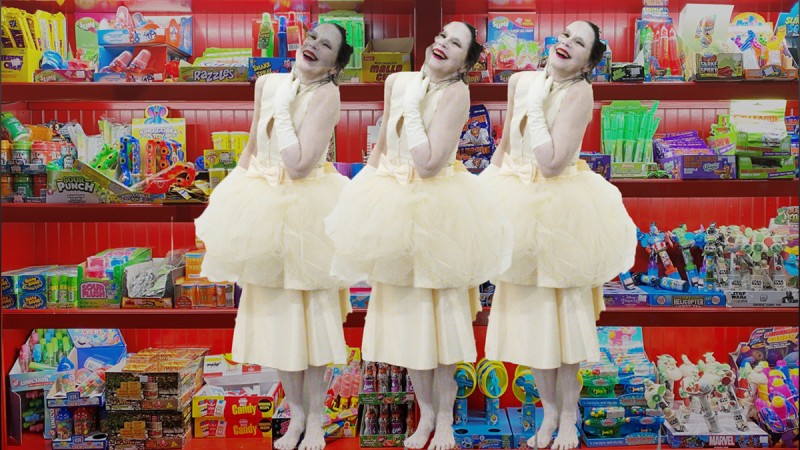
Sugar Plum Fairy
Harnessed, harvested, honoured by Alessia Belsito-Riera
Artist William Franco pushes the boundaries of traditional sugar sculpture, working with a common material in new ways while staying connected to his Indigenous culture.
At Toi Pōneke Arts Centre, longstanding creative With Lime collaborators Franco and Miki Seifert present the explorative gallery experience Azúcar / Sugar until the 8th of August. I talked to Seifert about the exhibition, which comprises sugar sculptures, videos, and digital art to examine the connection between sugar, colonisation, global trade, and climate change.
What inspired the exhibition?
This installation started with a question. A friend asked Willie why he used sugar to make his decorative skulls for Día de Muertos/Day of the Dead. Years ago, Willie had travelled through Mexico and learned the traditional method for making sugar skulls, but he had never stopped to question why they were made from sugar.
This led us to an exploration of how sugar has shaped our world with a special focus on the role it played in colonisation and the development of global trade. We traced sugar’s journey from a luxury spice to a global commodity, revealing its central role in building international trade networks and economic systems that defined the modern era.
We wanted the installation to recognise how this expansion affected Indigenous communities, whose traditional ways of life were often disrupted as land was converted for sugar cultivation. Many lost access to ancestral territories and saw their cultural practices change as colonial systems took hold. We also wanted to make connections between sugar’s environmental impact and present-day environmental crises. Colonisation and large-scale sugar production altered entire ecosystems, clearing forests and changing local water systems. These environmental changes, along with the health impacts of increased sugar consumption, continue to affect communities today.
What do you hope visitors take away from the exhibition?
We hope visitors leave with a deeper understanding of this fundamental shift in how humans relate to the natural world. When you see a sugar skull at a Day of the Dead celebration, we want you to recognise that it’s not just a beautiful cultural tradition – it’s part of a much larger story about how different cultures view the relationship between people and the environment.
Our goal is to help audiences understand how sugar production became a symbol of this transformation. Indigenous communities often saw land, water, plants, animals, and humans as interconnected living spirits. The colonial approach treated these same elements as separate resources to be extracted and converted into wealth.
We’d like people to think about how this shift affected not just the physical landscape, but entire ways of understanding and living with the natural world. Many Indigenous communities lost not only their ancestral territories, but also their traditional relationships with the environment.
Most importantly, we want visitors to leave questioning how we might reconnect with more sustainable ways of seeing our relationship with the natural world. By understanding how sugar’s story reflects this broader transformation, we can better appreciate and consider what it might mean to treat the environment as a living entity rather than just a source of profit.
View more articles from:
« Issue 248, July 15, 2025