

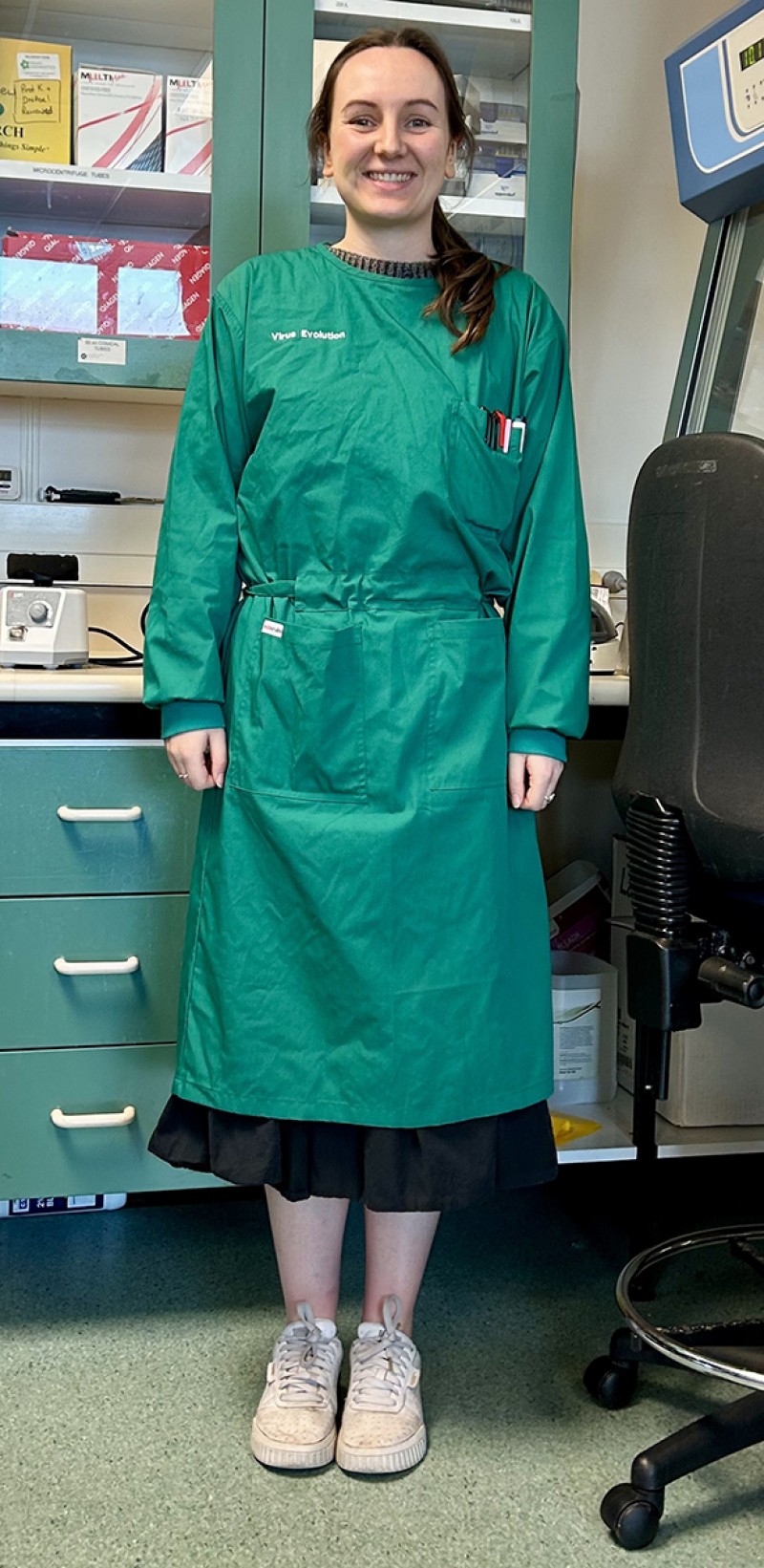
Going viral by Isabella Smith
Dr Stephanie Waller was awarded the Zonta Science Award by the Zonta Club of Wellington in June this year for her contributions to the study of viruses in native wildlife in Aotearoa and her commitment to advancing women in science. We caught up to discuss her research, her work inspiring young women and girls, and her plans to visit virology labs overseas.
What drove you towards science and researching viruses in wildlife?
I’ve always been interested in understanding how humans, animals, and the environment interact together. I was always out in nature, which led me to science and trying to understand those processes a bit better.
At the University of Otago, I followed what interested me and ended up in microbiology. I did my honours, then a PhD, which was where I really started looking at viruses.
Something that blew my mind in the first week is that there are more viruses on Earth than there are stars in the universe. We know less than one percent of all viruses so far, and there’s a huge amount to explore and discover.
What species have you been researching and working with?
Prior to my PhD there wasn’t much work done uncovering viruses in native species in New Zealand. My PhD involved trying to uncover as many viruses in as many species as possible to get a baseline understanding of what is in New Zealand and how these species evolve, particularly because they’ve been isolated for millions of years.
I had the privilege of working with pekapeka (long-tailed bats) and short-tailed bats. I also looked at viruses in tuatara, longfin and shortfin eels, and several mokomoko species (skinks and geckos).
Since then, I’ve done a post doctorate. I’m in Professor Jemma Geoghegan’s lab in the microbiology and immunology department doing a range of projects. I’m looking at avian influenza surveillance, which is super relevant with H5N1 detected in New Zealand recently. I work with livestock viruses found in cows and pigs in collaboration with the Ministry for Primary Industries. Also human viruses, looking at how they are associated with cancers.
Does that mean you end up having a much broader understanding about other areas of science?
Yeah, definitely. I come at it from a virus evolution lens. But with every new topic, you’re picking up new knowledge and collaborating with new people. There are two ways in science that you can go. You become either a specialist in one field, or you learn a technique that can be applied across multiple different projects. My technique is looking at metatranscriptomics [the study of gene expression of microbes within natural environments] and genomics and I can apply that across a range of areas.
What would be some of the most interesting findings?
We were really interested in tuatara because they’re one of the most evolutionary distinct vertebrate species on Earth. We found hardly any viruses that appeared to be directly infecting them, which was quite unusual. We hadn’t found that in any other species before. We thought potentially they do have viruses but they’re so divergent to anything we know about that we can’t identify them.
In some bats we found a virus similar to ones found in Australian bats. It likely indicates that long-tailed bats harboured this virus prior to coming over to New Zealand millions of years ago. That was interesting: showing that viruses can diverge with their hosts for millions of years, and that you can link that back to their evolution and how they moved across different countries.
The other aspect of the award is for championing women in science. Who are your heroes?
For a lot of people, your heroes are found quite close to home. For me, that was my high school biology teacher and chemistry teachers.
After that, I’ve been extremely lucky to have had a bunch of female mentors along the way. My current supervisor, Professor Geoghegan, believed in me and all the other members of our lab and has provided us with so many opportunities to thrive and develop.
I worked with Maree Roberts on the transitional infectious disease platform, and she helped me see a clearer link between policy and science. She’s still a mentor today. It just goes to show that if you have a strong community and strong mentors around you, they can help you succeed.
Unfortunately, that isn’t the case for everybody. While there is a lot of improvement, with a lot of female scientists coming through university, there’s still a huge lack of female scientists within higher leadership. It’s hard for women who are in those roles to be able to mentor everybody. They’d have to do twice or triple the amount of work to mentor all these female students.
To improve those outcomes, what have you been up to?
Over the years I’ve been involved in several organisations. Chiasma is a student-led volunteer organisation that links industry with scientists and students. People are going into science then don’t really know how to get into jobs. There’s a strong emphasis on getting female leaders within those industries to share their experiences.
I’ve recently been involved in Inspiring the Future Aotearoa. You volunteer yourself as a mentor, and high schools can reach out and ask you to come in to spend a morning or afternoon with the students. You explain what you do, the things you like about your job, the things you don’t. That work is really important, targeting young girls and showing them that there is a place for women in science.
On that note, what do you like about your job?
I like that I can help people. I do a lot of demonstrating and supervising students. It’s nice to answer questions and provide information to people in a way that they can understand. I think science communication is so important. There’s a lot of misinformation out there. I also like generating new knowledge. I’m often uncovering things that no one’s ever discovered before.
What are you going to do with the award money?
I’m going to use the money that Zonta has given me to go over to Europe. The first visit is to the University of Cambridge to meet Dr Chris Ruis. He focuses on this very technical term called mutational spectra analysis.
After that, I’m going to the University of Glasgow to meet Professor Daniel Streicker. He focuses on modelling how viruses move between wildlife. I’m really interested in learning about what he does, particularly with avian influenza and H5N1, then try to model how the virus could potentially be spreading throughout New Zealand.
After that, I’m going to the Pasteur Institute in France to meet with Professor Sebastian Duchene. He works on looking at the evolution of viruses, which is similar to what I do, but his techniques are different.
All these techniques and tools I’ll learn can be applicable not just to one virus but to all the viruses I’ve been working across, which is really important. The aim is to use and transfer that sort of technology to other researchers within New Zealand as well, so we can better build up our capability and capacity.
Sounds like you’ll bring back a big kete of knowledge.
That’s the plan. And to collaborate. It’s so important in science that you’re collaborating and sharing knowledge. A lot of these problems aren’t just a New Zealand problem. Viruses like avian influenza, they go across borders. How one country is dealing with a situation is so important in understanding how we’re going to deal with it.
I’m extremely grateful to have this award. It’s going to be extremely beneficial to me, but it’ll also hopefully help raise more awareness of the work that scientists, particularly female scientists, are doing in New Zealand.
View more articles from:
« Issue 274, August 11, 2026