

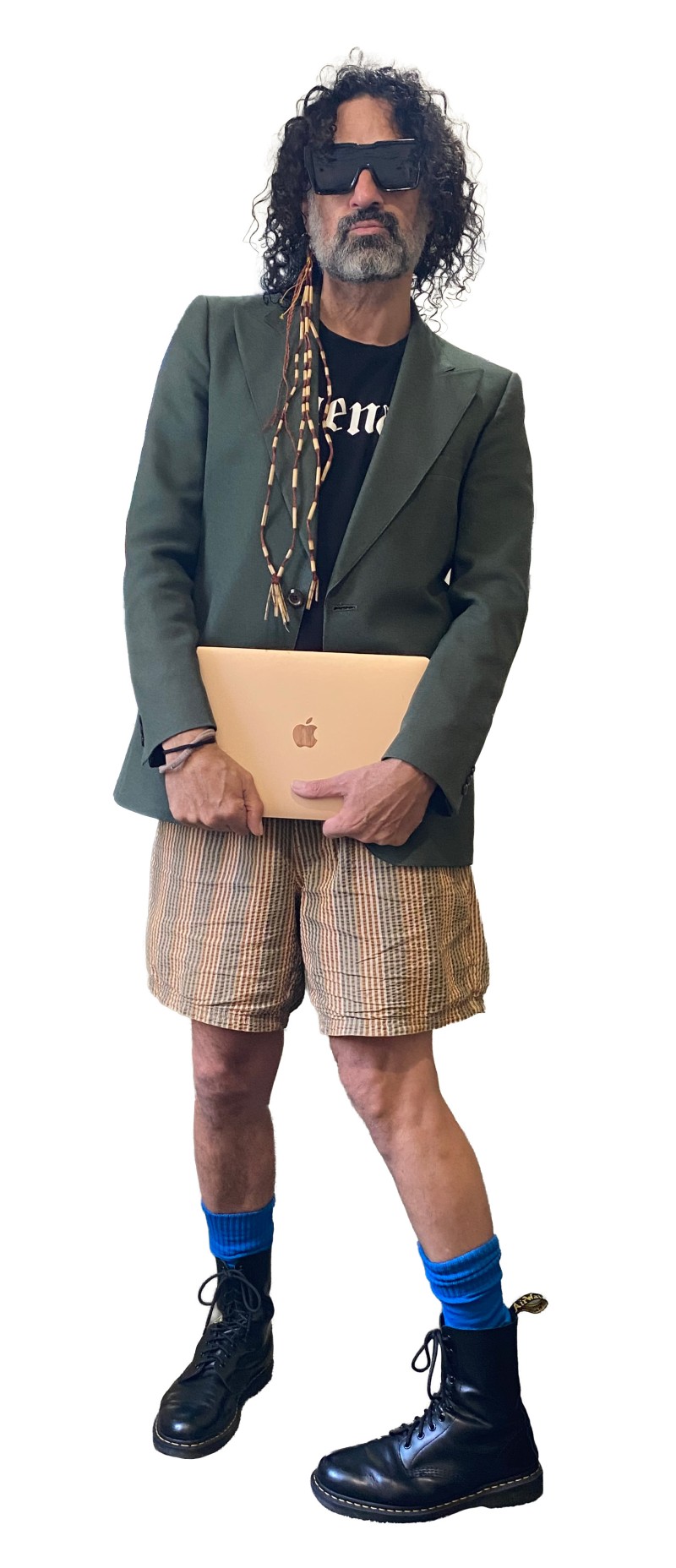
Go towards truth by Madelaine Empson
Tawhi Thomas (Ngāti Maniapoto) has just won Best Play by a Māori Playwright at Playmarket’s 2026 Adam NZ Play Awards. His winning work Haere is about “intimate connections, or missed connections, between humans”, the writer, actor, director, and teacher tells me.
It’s by no means the first time Tawhi has scooped up at the ceremony – his play Pakaru took out the 2019 Adam NZ Play Award, making him the first playwright to win the prestigious prize twice.
We got down to the nitty-gritty about Haere and more.
Congratulations on your win! Can you tell me about the play?
It’s a bumpy ride of punchy vignettes where I’m exploring, specifically, bicultural dynamics between Pākehā and Māori characters. It’s high tension, straight in there with each scene. The longest one is maybe 10 minutes and there are 10 scenes in all. Each scene takes place in the context of a journey, or on some kind of transport, or is to do with travel and getting somewhere, hence the name Haere.
Ambitiously, but I think I’m pulling it off, each vignette takes place during a different era throughout our modern history. We start off with a runaway bride in 1864 and end up time jumping through decades. Then, something really freaky happens when we get to 2024: the next scene is called Now, and the scene after that is called What is time anyway? It turns meta: like a koru, the whole play curls in on itself and starts commenting on itself, and we meet the characters from all the other vignettes.
What was the process from inspiration to concept to completion?
I had this hunch several years ago that I wanted to do a piece called Haere. It would be vignettes because I wanted to move away from the three-act structure, the well-made play, the hero’s journey. I wanted to be playful and not worry so much about form, and I wanted to explore fragments of human interaction. It sat on my stovetop for several months, gathering a bit of dust. In 2024, I pitched it to the Kōanga Festival at Te Pou Theatre in Auckland, which is a development festival for new Māori writing. I got in and became part of a year-long writers’ group. We had a really good workshop with actors, a director, and a dramaturg, and that’s where the draft became realised. It had a public reading and it was kind of a smash hit!
Are you always, often, or hardly involved in the process of getting your work from the page to the stage?
I’ve been doing this for 30 years now, so I’ve had a real mixture. When I was a young fella starting off at BATS in the early to mid-90s, I wanted to do everything. We were being awesome and young and deep 90s and doing it on the smell of an oily rag. But I kind of had a breakdown about it [chuckles], because I wanted to write, act, direct! All at the same time!
When I kept writing and started to get more confident, find my real voice, and consistently started getting good notices, funding, and encouragement, I began handing it over to my trusted peers and colleagues – who were getting to the top of their game as well in terms of lighting, direction, acting. Handing it over to them completely and just turning up on opening night in a really great outfit to see what they came up with, that proved really great. It was the best feeling, to turn up and have my dream realised by trusted colleagues.
When you’re not involved, what does it take to release the work – it sounds like trust is a big component?
It’s completely about trust. And in saying that, as I’ve gotten older and more mature – and I think my teaching has informed this as well – I’ve gotten more confident to direct my own work. I don’t feel the need to direct every single one. But for example, I directed my play Pakaru, which was really successful back in 2019. That was really satisfying.
When watching your work on stage, what has most surprised you?
This makes me go back to my love of actors. Every single time – even though I’ve trained as an actor myself, and I did a stint helping train actors at Toi Whakaari a few years back – I’m utterly refreshed and blown away and completely surprised by the courage that our local actors have on stage. I don’t pull any punches. I’m asking people to go into shadowy corners, to be really laid bare in my work. Hone Kouka once called me the Prince of Darkness because of where I like to go with my characters. There’s always laughter, always aroha, but I do ask a lot of the actors who want to jam with me in my scripts. I’m constantly surprised by their openness and their courageous talent.
What does it mean to you to win at the Adam NZ Play Awards and what do you think makes Playmarket special?
I think it’s just the reality that there is someone every year who wants to acknowledge us as writers. We get bugger all in this country. It’s the fourth time I’ve won Māori Playwright, and I’ve won the overall big one [The Adam NZ Play Award] twice, and a really dear friend of mine said to me once, ‘You’re just being greedy now.’ We both laughed, but actually, that is a bit of a joke. Because there is no such thing as being a greedy writer in Aotearoa. There’s just so little to go around. So to have ongoing support, recognition – from Playmarket and the Adam Foundation for these awards, and also local awards like the Wellington and Auckland Theatre Awards – is a great, constant lifeline of tautoko. We know we’re not doing it for pūtea, for money, but it’s good to have that feeling of support.
My favourite thing about the Playmarket Adam NZ Play Awards is by far when you get to go and you see scenes from all the finalists. It’s incredible, I was completely blown away by the one they just had in Auckland. They flew me up, I had a great day, got to hang out with my actor friends and writer friends, met some new writers… It was great to be in the mix, but it was really great to see and hear where everyone’s at. It’s a super healthy, wondrous community of writing that’s going on right now.
From writing to acting, directing to teaching; from page to stage to screen and back again, why do you do what you do?
When I was younger, it was like I didn’t really even have a choice: I found out really early on, this is what I’m here for. I’m here to tell stories. When I was young, it was an ego-driven, youthful, energetic drive to be heard. As I’ve matured, I’ve realised it’s actually not about me. That artists truly are vessels for a bigger energy to come through – an energy that is always seeking an audience. It’s always seeking people to help, to heal, for them to be seen, to be heard, through our artform.
We’re living in a world that has just gone so crazy, and the power of storytelling is now more important than ever. There’s a reason storytellers and artists are shut down by dictatorships and far-right regimes. That is because we encourage people to go towards truth, and to act on what is right. It sounds lofty, but that’s why I keep doing what I keep doing.
View more articles from:
« Issue 268, May 19, 2026