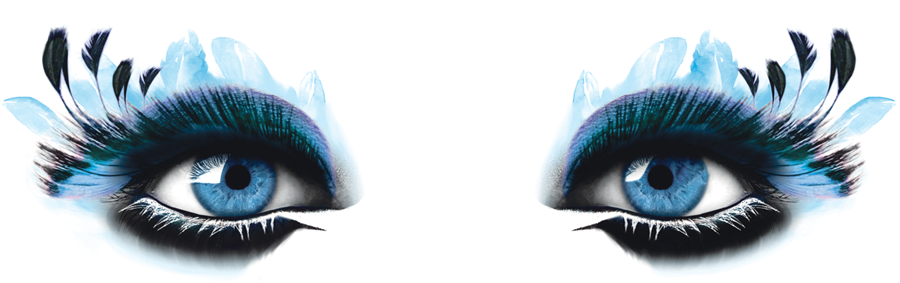

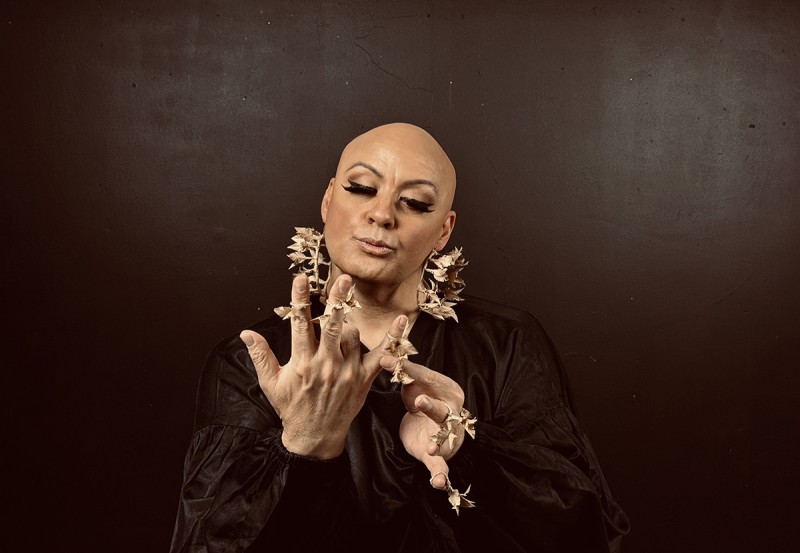
Lindah Lepou™, (Ai)TU™ series, 2026
Photo by Lisa Fa’alafi (FALE'AITU)
Flip the gaze by Isabella Smith
The Sāmoan word aitu can be translated to mean ‘ancestor’, ‘spirit’, ‘invisible watcher’, and ‘observer’, while mata means ‘eyes’.
Mata’AITU (voyeur) is the second instalment of the (Ai)TU™ Series, created by Lindah Lepou™ and developed out of a research trip to Siamani (Germany). There she retraced the footsteps of her ancestor, Tolio, a 10-year-old boy taken from his parents in Sāmoa and brought to Siamani, where he was part of a Sāmoan ‘troupe’ put on display in a Völkerschau, a human zoo, and made to perform. In Siamani, she examined ethnographic histories and the colonial violence of human zoos where Indigenous peoples were displayed, watched, and dehumanised.
The (Ai)TU™ series looks at the psychology of voyeurism, developed by the likes of Jean-Paul Sartre, Sigmund Freud, Richard von Krafft-Ebing, and Alfred Binet. By tracing the digital world back to its roots within human zoos, she recognises a continuation of the same behaviour and business model that perpetuates colonial violence, fetishisation, and surveillance in today’s talk shows, reality TV, pornography, social media, and AI algorithms.
The exhibition begins examining the Colonial Gaze. Using AI, she activates the static image that captured Tolio, transcending the power dynamics to see him walking out of the human zoo enclosure. Lindah describes this as “generative AI regenerating (Ai)TU™”.
Next, she observes the Cinematic Gaze that developed out of technological advancements, screening controversial filmmaker Robert J Flaherty’s 1926 film Moana, which shows Lindah’s great-great grandmother Fa’agase making siapo (Sāmoan tapa), captured for Western audiences who have consumed the footage for 100 years.
The exhibition ends with Fa’afafine, “a satirical flipping of the gaze onto our Western society and culture”, where Lindah puts herself “on display, to be consumed by global audiences of voyeurs”.
While the concept and business model hasn’t changed at all, “The power dynamic appears to have shifted”, Lindah says. “The digital space provides a more level playing field where I – the artist, the fa’afafine, the Samoan, etc – can choose and control what and where I share my image and/or story in the world (or not).”
As a fa’afafine artist and fashion designer, Lindah has been registering her names, concepts, and digital assets for nearly two decades to safeguard them against individuals, countries, and corporations that steal Indigenous identities, cultural practices, and rituals.
“In 2026, none of that has changed; it has just evolved technologically, where our ancient names, images, stories, songs, art, gods/goddesses, etc, are stolen in digital formats.”
Works of remembrance and resistance honour aitu and fa’afafine as multidimensional gender archetypes – transporting, transforming and enduring.
“Being fa’afafine in today's society is automatically a 'disruption'. My mere existence is 'a problem'… for a society that can only control what it can pigeonhole. As a multidimensional artist and entrepreneur, this keeps my life experience open and fluid enough to weave in and out, up and down, my own gafa (lineage, whakapapa) aitu with little to no fear.”
Posing the question, have we evolved or devolved, Lindah Lepou™’s exhibition Mata’AITU (voyeur) is on at Pātaka Art + Museum until the 8th of November.
View more articles from:
« Issue 276, September 8, 2026