

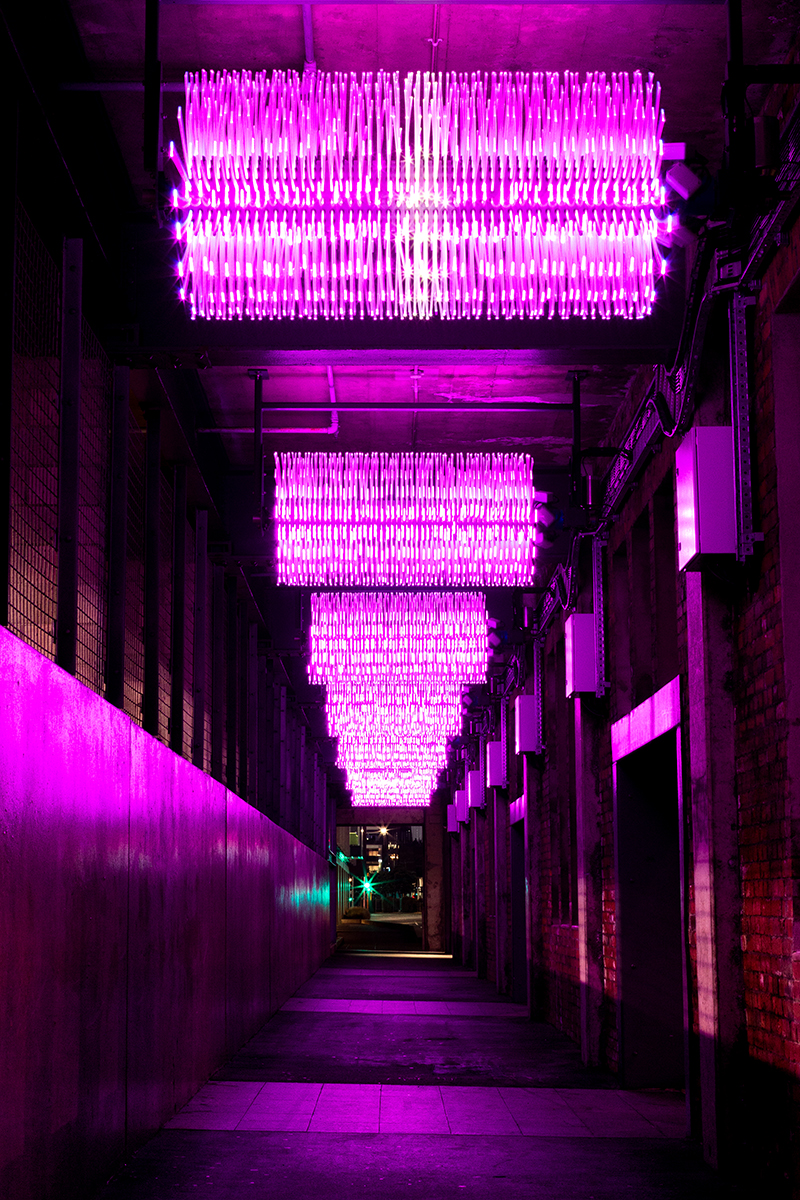
Photo courtesy of Wellington Sculpture Trust
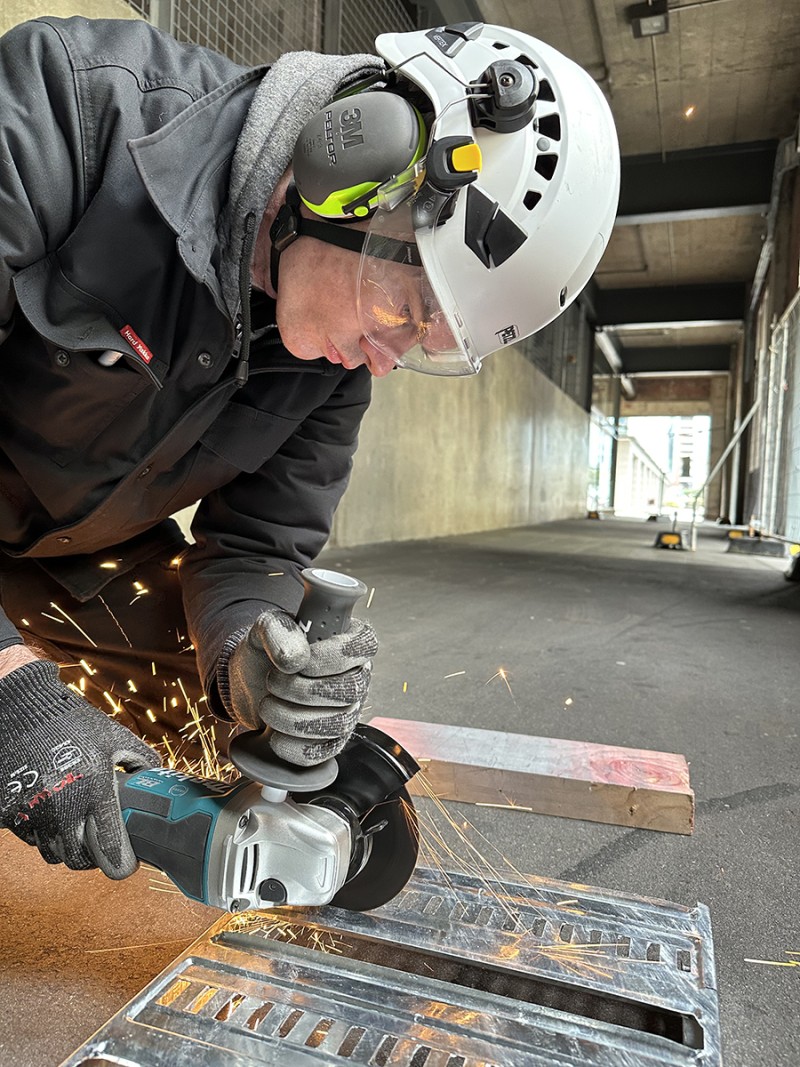
Eddie Clemens
Fibre-Optic Colonnade Carwash by Isabella Smith
In this new series, Isabella Smith talks to the artists behind the sculptures dotted around our city.
The narrow, architectural corridor outside the historic brick building Shed 21 runs alongside Waterloo Quay, linking the train station with Wellington’s waterfront. A well-worn path for commuters, situated in a transport zone beside the Bluebridge Passenger Terminal, a sculpture down this dark, cheerless wind tunnel has to contest with heavy foot traffic and a harsh mix of wind, rain, soot, and saline air.
Fibre-Optic Colonnade Carwash is one of the most ambitious public works installed in Te Whanganui-a-Tara by the Wellington Sculpture Trust to date. A kinetic, light-based sculpture fitted onto the ceiling of the colonnade, it now forms part of the city’s flow, illuminating the environment and adding depth, movement, and whimsy to the pedestrian thoroughfare.
Consisting of seven rotating roller-brushes, each containing 1000 programmed LED strips and side and tip-glowing fibre-optic cables, the sculpture behaves like a carwash, washing commuters in moving patterns of light and colour.
The seven brushes are programmed as one synchronised system, unfolding through chapters of animation and movement. As the drums rotate and the light shifts across the full length of the colonnade, commuters experience something akin to the physical and perceptual sensation of being inside a car wash: the apparent motion of the surrounding environment.
Tāmaki Makaurau-based artist Eddie Clemens has been working with kinetic sculpture since the late 1990s. With no formal training as an electrician, the creation and installment of this mechanically and technically complex work involved many hats and a huge amount experimentation, troubleshooting, and collaboration with industrial designers, electricians, engineers, construction workers, programmers, animation artists, council, residents, and of course, The Wellington Sculpture Trust.
Clemens and his long-time collaborators Mitchell Hughes and Dave Branton developed a custom web-based system to run the sculpture which controlled both the animated light programme as well as the motor speed and direction of the fibre-optic brushes. Each were programmed to their own rhythm, allowing for the moving light images to be synchronised with the movement of the drums. “I was interested in that alignment”, he says. “The sense that light, motion, and structure are all moving together.”
Cinema has always been a reference point in Clemens’ work, “How objects can hold a narrative charge without resolving into a fixed story.” With the fibre-optic rollers mounted in a row above people who pass through the long, narrow corridor, it is as though they are walking through a fixed scene, with the colonnade becoming “a kind of camera path,” and the viewer becoming “both the audience and the thing being washed through the image”.
The sculpture is also concerned with time and subjectivity. Programmed to run at peak commuter times, the public only view it in fragments. Witnessing only a moment of the colourful animations, they might be caught awash in a pink glow, or behold lights flood down the corridor in a multi-coloured tide. One of the chapters is an expanding colour field that slowly washes through different colours in the same direction as the brushes rotate.
“I work conceptually and technically in a hand-in-glove way” Clemens says. “From the outset, I wanted full control over the supporting electrical infrastructure because I see it as part of the work rather than something separate”. Being able to see the mechanations and practical aspects in the work is part of its philosophy.
“With Fibre-Optic Colonnade Car Wash, everything is overhead, but it has been designed so it can be accessed by an elevated work platform, and all components are waterproof-rated for the exposed waterfront environment. I have left parts relatively exposed, in a high-tech architectural fashion, so that preventive maintenance is easier in the future. After all, it is a car wash – it is designed around the idea of maintenance.”
Down in Pōneke for six weeks he worked long days on-site in volatile spring weather, having brought tools and all the sculpture’s components down in a 40- foot container. Together with Peak Electrical, he laid several kilometres of cabling and connected all eight electrical boxes, which had been pre-built and wired in his studio in Auckland.
A huge amount of industrial design, product, and technical testing was done before reaching the site. It was a “long ordeal of assembly and troubleshooting” particularly around electrical and electromagnetic interference, with Clemens “dealing with powerful electrical systems sitting alongside very sensitive control and signal systems. So much of that process came down to trying, adjusting, and testing things in real time until the whole setup behaved reliably.”
Reading Frankenstein during its development, he felt a shared kinship in the bringing of a complex system to life, “blow by blow” as he “chased glitches through the system”.
City Gallery Wellington Te Whare Toi senior curator Aaron Lister says, “Eddie Clemens is a total maverick. His sci-fi-tinged work is meta in its range of references and operations. This kinetic light sculpture comes from a line of glowing fibre-optic brooms and hand scrubbers, of materialised fences and bridges that are put to work in and on specific spaces. His transformation of a dingy pedestrian colonnade into a fibre-optic, automatic tunnel car wash that is to be walked (not driven) through is out-of-the box brilliant thinking. It perfectly marries concept, a decade’s practice, and technology – all turned towards the specific dynamics of a very challenging site.”
The sculpture runs every day during peak pedestrian times: on weekdays between 7am and 9am, 12am and 1pm, 3:30pm and 6:30pm, 8pm and 11pm, and for 10 minutes on the hour in between those times until 11pm, and on the weekends between 11am and 2pm, and 8pm and 11pm.
View more articles from:
« Issue 268, May 19, 2026