
Portal 4, 2026
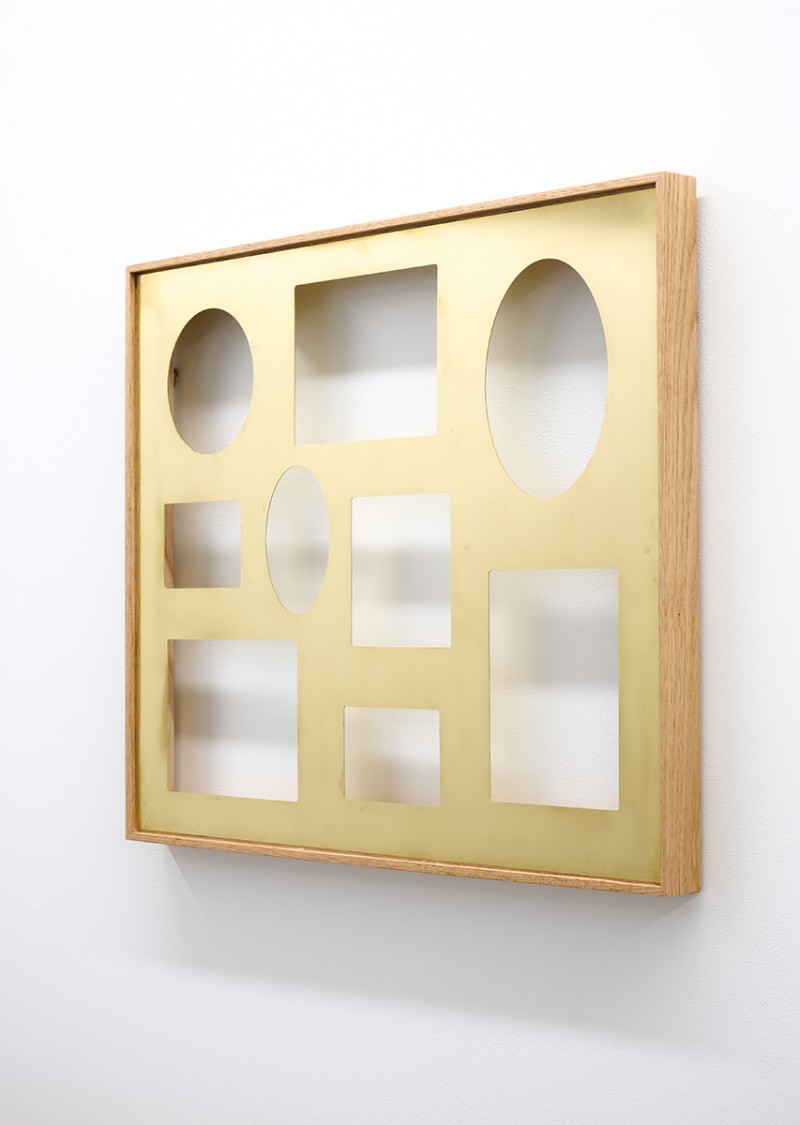
Photo by Adrian Vercoe, courtesy of Jhana Millers Gallery.
Elemental beginnings by Isabella Smith
In Tom Mackie’s exhibition Portals, on at Jhana Millers Gallery until the 11th of July, each artwork captures its medium in a moment in time. Made of brass, reclaimed timber, and calico cotton, they reveal material vulnerability, celebrating signs of wear and traces of affect. Each stain and scar remind viewers that the present moment behaves as a nexus connecting the artwork to its elemental beginnings.
Tom Mackie is an artist based in Te Whanganui-a-Tara. Across a range of projects, he draws attention to the build-up or ‘collateral’ that conventionally sits outside of objects, obscured from view. Working with discarded canvases, found materials, and reclaimed surfaces, he is interested in the after-effects of creative production: residues, impressions, and other traces left behind.
Wood moves, brass oxidises, and rather than removing the evidence of time and history working on them, it is instead archived, leaving a feeling of a nostalgia on the walls of the gallery. New life is breathed into a ‘ghost print’ taken from the backing board of a Robin White screenprint of This is me at Kaitangata, 1979. Its reinvigoration and re-presentation enable the histories the work embodies to interface with the present moment anew.
The grain, rings, and discolorations on the surfaces of reclaimed wood create chance beauty that encourages the eye of the viewer to drift out to the peripheries. “I’m trying to slow down the viewing experience”, Tom says. “When the centre of the artwork is empty, there is no ‘image’ for the viewer to look at and our eyes are forced to wander, to breathe, to notice subtle textures. I want the viewer to discover, to decompress in front of the work, to slow down and create their own story.”
Similarly, the geometric cutouts on framed sheets of brass invert exterior and interior space and, too, draw the eye outward. In the accompanying essay from arts writer Nina Dyer, she says, “Whereas conventional frames may be thought to insulate a work from the scaffolding of a gallery’s walls (and by extension, its wider institutional apparatus), the works in this exhibition make no such distinction.”
“I want a partnership with my material, instead of having total domination over them”, Tom tells me. “There is a calm battle between control and surrender in my work... A friction between vulnerability and perfection.” In contrast to the archival impulse is a more rigorous practice. Near-perfect spherical orbs line the bottom of the wooden frames; hard evidence of a machine or a hand articulating the material into something else. This second tendency toward the anti-gestural creates smooth, linear, geometric shapes that complement the living archives.
Dyer says the work is “neither overtly expressive nor purely abstract, it holds a place in which material memory and formal restraint coalesce, allowing historical layers to assume renewed significance.” This restraint allows materials to speak for themselves, to behave like portals that have a story to tell of their own.
View more articles from:
« Issue 271, June 30, 2026