
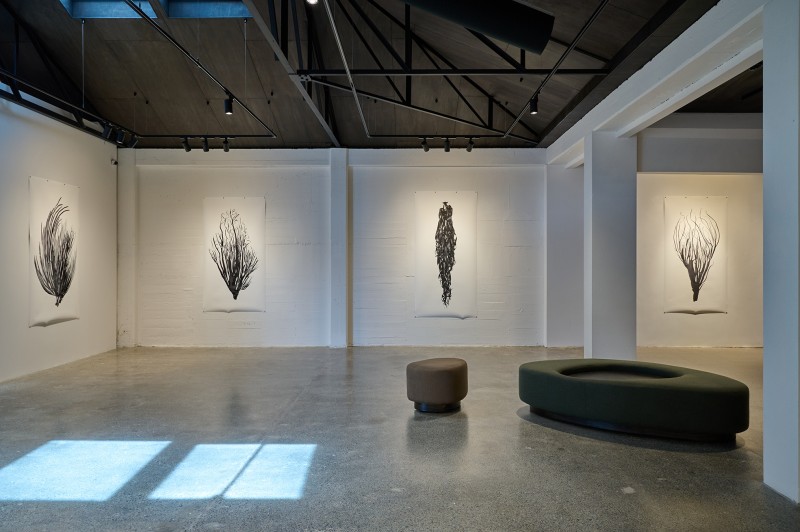
Installation view, Kōrimurimu. Photo courtesy of Nine Fathom Deep.
Different kinds of containment by Isabella Smith
When big southerly storms collide with the south coast, tearing rimurapa (bull kelp) from the reef and washing it onto shore, photographer Neil Pardington (Kāi Tahu, Kāti Māmoe, Ngāti Kahungunu, Pākehā) gathers it from Te Raekaihau Point (the headland that eats the wind) and Huetepara (the ripe gourd) Lyall Bay.
Within Kāi Tahu and Kāti Māmoe traditions, rimurapa is embedded in mahika kai (food gathering), where it is used to make pōhā, an airtight receptacle designed to carry and preserve things like tītī (mutton bird).
In mātauranga Māori, rimurapa is inseparable not only from the wider ecosystem, but from the genealogy of the cosmos itself. Western scientific traditions of collecting, classification, and representation, on the other hand, isolate and decontextualise specimens from their environment.
Neil’s large-scale, gothic black-and-white photography is situated in the tension between Indigenous and Western modalities. Like scientific taxonomy, the photograph too isolates and fixes, yet Neil’s images resist being understood solely as an object of study. Their significance as carriers of both material and knowledge are still present, making them representative of two very different kinds of of containment, while also asking viewers what might be lost or displaced.
Former curator of City Gallery Wellington Te Whare Toi Courtney Johnston described Neil as working “in the space between documentary photography – where the defining principle is to capture the truth about the world – and conceptual photography, which contends that such a truth can never really be depicted”.
Once rimurapa is removed from the ocean, it goes limp, no longer able to hold itself up unless shaped by human hand. After taking the images, Neil returns it to the south coast, where it slots back into what Kāi Tahu historian Te Maire Tau calls “the world of plants, fish, rocks and stars”. The exhibition Kōrimurimu is on at Nine Fathom Deep until the 3rd of December.
View more articles from:
« Issue 281, November 17, 2026