
Counter-culture connoisseur by Alessia Belsito-Riera
“There is so much in life that is mysterious and unknowable,” creative force of nature Dinah Priestley says. “If art can do anything, perhaps it’s to help make sense of things you can’t explain in words.”
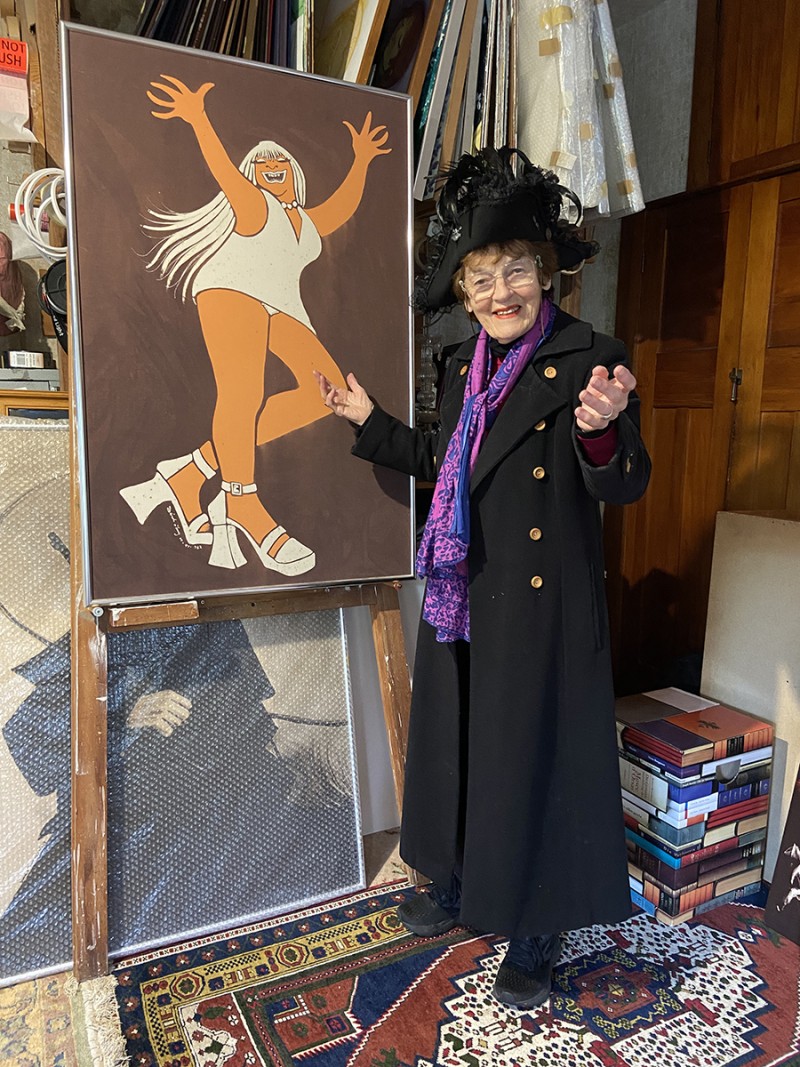
The Wellington artist, author, actor, broadcaster, and cartoonist has had a monumental career across her variegated subjects of interests, most recently donning her writer’s cap to craft An Eccentric History in Batik, which has been described as an alternative history that highlights New Zealand’s diversity; a visual and cultural time capsule that spans art, theatre, protest, and partnership.
As much as it is an ode to Aotearoa and the people who call it home, An Eccentric History in Batik is also a love letter to her late partner and collaborator Tony Burton, their shared work, and the life they created together. Their art hangs in galleries and homes in Paris and London, New Zealand and Australia, Priestley tells me, “but we’d always wanted to have the images and stories in one place, as a legacy”.
Available in bookstores across the motu from November, An Eccentric History in Batik is as much a record of creative rebellion as it is a story of love between two artists, and between those artists and their country. As witty, heartfelt, and sharp-eyed as her life’s anthology, Priestley tells me her story in full technicolour.
What role does art play in your life?
Art influences almost everything I do, every day. It’s essential. I’ve always loved making things and I love the feeling that a painting or a story or mask you’ve just created didn’t exist a few hours before. I carry a sketch book with me everywhere to capture what my eye is hooked by. What interests me is people and the expression they wear when they are intent on something. If you can learn to sketch what affects you, what you like, then it will affect others. That is what art is. In art, as in all creative work, I believe we are all eclectic, constantly borrowing from other people. We seldom do anything entirely on our own.
You have worked across many disciplines – how do you balance them all?
I’ve always found it useful to have several creative works on the go at once – batik [a dyeing technique using wax resist], paintings, cartooning, masks, puppets, writing books, and radio programmes. They all seem to feed into each other. I think they are all just part of my brain and they influence what I do. Whatever strikes my mind at a particular moment – whether it is something humorous or some injustice I’ve witnessed – it seems to have a way of coming out through an artistic response. I like that these mediums all have different impacts. Batik employs precision, preplanning, and a fundamental sense of line and shape. Painting is freer in its execution, allowing a more mysterious process to take place. Cartooning and mask-making deal in caricature and joyful exaggeration, which are excellent tools for social commentary through humour.
What have been some career highlights?
I find it very hard to say. Some of my protest work would be my best and most rewarding. I do get passionately angry about some causes, but I believe humour is often the best way of translating anger. It delights me when I manage to make people laugh. I suppose it signals that I have half won them over. Perhaps I’m a propagandist for my own beliefs.
We created some challenging batik work around the 1981 Springbok tour in New Zealand, working on techniques that captured the emotion of the time, but also New Zealanders’ humour and individuality. I really enjoyed cartooning a series of wonderful writers and poets for PEN NZ Society of Authors and I have created a particular chapter in the book for these works. And I still love some of the children’s books I have written and illustrated like Oscar, Star of the Opera, about a dog who becomes a canine Pavarotti, and That’s Not Cricket inspired by Tony’s engaging cricket team.
What is special about batik?
Batik is a medium that a lot of people don’t know about and yet it is an ancient artform – far older than oil painting. It has been practised for thousands of years in places as diverse as India, China, Indonesia, and Africa, as well as in Pacific Rim countries.
I first saw batik when, as a teenager, I lived in Malaya with my parents and family, but it was not until I was living in Zambia that I started batiking. African art intrigued me and the work of Susanne Wenger, an Austrian artist working in Nigeria.
In batik art, hot wax is applied to cloth and acts as a resist. The cloth is then dyed, waxed again, and redyed in ever darker hues until a picture is built up. The wax is then removed. Although two batiks can be made from the same sketch, the way the wax cracks on each batik will be unique: no two can ever be the same.
Tony and I knew that batik could combine our skills and interests into an art business. I would bring the design skills and Tony the technical expertise in different waxes and dyes. I guess we have used a largely African, Asian, and Pacific artform to express Western ideas. But perhaps that is indicative of the way New Zealand has changed and redefined itself as a true Pacific Rim country, no longer tied to the strings of Europe.
What inspired An Eccentric History in Batik?
I wrote this book for all sorts of reasons. Tony and I knew that we wanted to capture our creative take on New Zealanders across the 40-plus years of our art collaboration. In late 2019, Tony was diagnosed with terminal cancer and had four months left to live. Since then it became urgent for me to write this book, which is in ways a love story to Tony, to our family, to all the wonderful people we have met and portrayed, and to New Zealand in general.
It intrigued both Tony and I that amid all the dehumanising elements of our society, the constant pressures of mass media and advertising urging human beings to conform, people remain funny and loveable and taciturn and often delightfully eccentric. To us this seems worth celebrating. And so much of our work, whether it is set in the present or the past, is about human nature and the odd quirks of national character.
Tell me about the content.
Over the 40 years or so of Tony’s and my work together we have become fascinated with a wide range of events and people that have or are still shaping this country. Dramatic stories, flamboyant and violent characters abound when you scratch the surface. Tony and I have travelled throughout New Zealand, rather like butterfly collectors, chatting to locals and researching interesting personalities and events. We were drawn to intriguing stories, journals, local histories, court transcripts, and newspaper cuttings. Our work explores a range of material from Captain Cook’s voyages, the New Zealand wars, and terrible injustices that continue to resonate, to social clashes and everyday colourful characters from all walks of life. Part of the knack of making history come alive is showing that characters from our past were just as complex and flawed as we are today.
What did your selection process look like?
This was a hard process. Of the hundreds of images we have created we had to narrow our choices down to images that had some action, were compelling, or captured the look of a strong personality. From a technical point of view our batik methods evolved over time, so we wanted to include our range of styles too. As well, the images had to be good examples of our techniques in terms of the drawing, wax, and dye elements.
What made you decide to give the book a humorous edge?
Humour remains the key, whether reflecting dire and desperate circumstances or the banalities of everyday life. Hope, humour, and imagination are beyond price, especially at the dark times in our history. I want people to enjoy my creations as much as I love making them. The old quote, ‘Make ‘em laugh, make ‘em cry’ is as true for the visual artist as it is for the performer. I hope it makes people laugh and resonate with the colour, the essence, the people, and the characters that make Aotearoa New Zealand the unique and special place it is.
View more articles from:
« Issue 256, November 4, 2025