

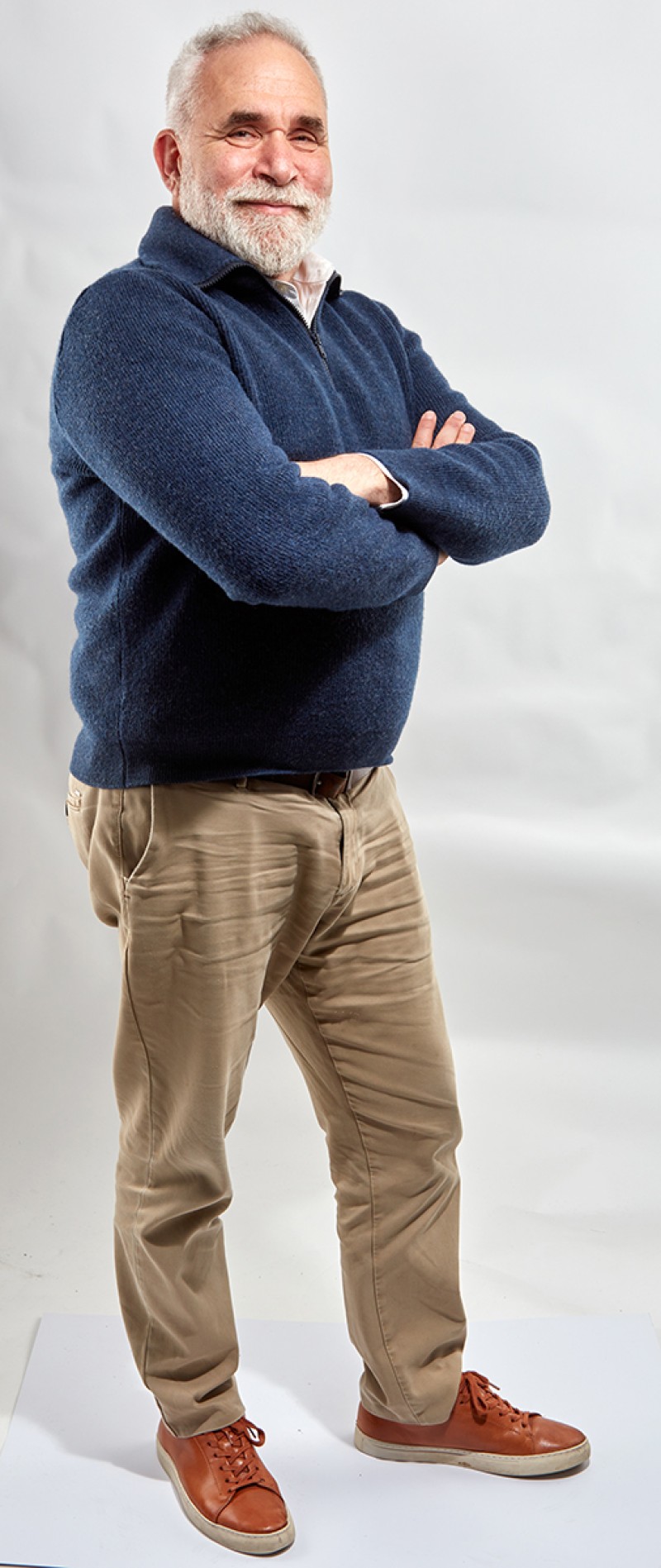
Photo by Andrew Empson
Confluence and collision by Madelaine Empson
Marc Feldman’s illustrious orchestral career has spanned four decades in some of “the most stunningly gorgeous places in the world”. From his time as bassoonist in both Lyon and Lisbon to working as a liaison between orchestral and musical theatre worlds at the Banff Centre for Arts and Creativity in the Canadian Rockies; from leading the Orchestre pour la Paix (Orchestra for Peace) to perform in the ruins of Petra for the 2005 Nobel Prize Conference to living in between Napa Valley, the Sierra Foothills, and the Sierra Nevada mountains, with Lake Tahoe on one side and the Pacific Ocean on the other as the executive director of California’s Sacramento Philharmonic Orchestra… it would take fewer words to list where he hasn’t been and what he hasn’t achieved.
In 2011, Feldman, who grew up in New York City, took up a position as the head of France’s renowned Orchestre National de Bretagne.
“I’m really proud of what I did there, and the people that I worked with and the amazing orchestra. That led me to say, after 14 years in Brittany, wanderlust gets you again. They call Breton the sailing country, because a lot of Bretons travelled around the world. And I say that I became an honorary Breton while I was there. So I said, ‘There’s only one thing I can do now that I feel totally at home in Brittany: leave,’” laughs Feldman, who hopes to go back one day. “The musical gods played a trick on me. They said, ‘Okay, you want to leave? You’re gonna go to the antipode of Britanny. To the exact other side of the world. We’re going to set you up in New Zealand.’”
Congratulations on your appointment as chief executive of the New Zealand Symphony Orchestra. What is special to you about the NZSO – what had you heard about it before you came here and what have you discovered since?
The thing that was very special to me about the NZSO is New Zealand itself. I was coming from Brittany, where there were dual or multiple cultures living in one spot – often confronting each other because the Breton culture was almost wiped out by the dominant French culture – but that duality was there. I saw in the orchestra they were taking on the mantle of that for New Zealand. I saw they were doing interesting things. The orchestra sounds phenomenal. The orchestra in Brittany was more of a chamber-sized orchestra. This was a full symphony orchestra, so that flattered my ego [laughs]. I learned about the film music they were doing, The Lord of the Rings, the other films they’ve done over the ages. The fact there’s going to be a new studio coming to completion very soon that’s going to open to the public in February, March 2027, the new Town Hall, the studios, the ambition of the orchestra, New Zealand itself... I said, ‘This looks like the place for me.’
How have you found the transition to living in Wellington?
Well, everybody was telling me from day one, ‘You’re going to freeze. The rain is going to be too much for you. It’s going to be windy.’ First of all, I find it spectacular. I love it. I’ve been tramping around and I’ve even gone for a mid-winter swim in Oriental Bay.
That’s bold!
I will tell any New Zealander, ‘Go to Brittany in January or February and you will find something very, very similar.’ We get nor’easters that come up the coast of the United States, cross the Atlantic, and hit Brittany with 160-mile-per-hour winds. We have these spectacular high tides and swells. I brought all my winter gear, all these nice, thick sailor’s sweaters because everyone said, ‘You’re gonna freeze to death’ and I’m too hot! The only thing is though, I’ve had two winters.
Oh, that’ll roll around.
It’s rolling around. I saw a really nice day... yesterday [laughs]. Another thing that I love about Wellington is I had a chance in my career when I was working in the States to live in Northern California, but also to work in Seattle, Washington and Portland, Oregon. Portland had a funny tagline to the city, ‘Keep Portland Weird’. I feel like Wellington has that vibe, and I really like it. It’s a challenge for an orchestra, how do we fit into this Wellington zeitgeist that I’m just beginning to explore. As one of the smallest world capitals, there’s this international side that is just fantastic. There’s a diplomatic corps – these world travellers who often go from post to post every three to five years. I feel a kinship to them as an orchestra director. I’ve been in the States, Canada, Portugal, Brittany, other places in France, now I’m in New Zealand, so I get their life. I love meeting them here in Wellington. I’m having a good time! And the orchestra is incredible.
What is your ultimate goal for the NZSO?
It’s hard to say right now, because we already are certain things. But I would like things to be more visible, for people to know that we’re a resource for all the creativity that an orchestra can be in New Zealand. I would like the orchestra to represent the specificity – and I need New Zealanders to help me with, ‘What is the specificity of New Zealand?’ I think I captured the specificity of Brittany in my orchestra. The Bretons are very down to earth, very direct, very proud of themselves. They don’t fancy themselves as terribly 100 percent French. They’re a little quirky, and they love their traditional music and their jazz. They love their place in the world. I think I was able to, after a number of years there, bring together the orchestra around what Brittany was. I’d really like to be, more than just a symphony orchestra in New Zealand, but New Zealand’s symphony orchestra.
The 2026 season has just been announced, and you said something very beautiful about it serving as a classical haven?
If we’re going to take our audience – our loyal audience and hopefully new audiences – and start a journey, you have to have a home base. If you set out from Wellington with no harbour to come home to, you’re not anchored in a sense of place. So this season is our sense of place. Of musical place, with so many great blockbuster, classical, romantic, Baroque, contemporary pieces. These are the pieces that everybody should know and love. I call it the permanent collection, like of a museum. That’s where we’re going to be starting from: the New World Symphony, Beethoven’s Ninth, Rachmaninoff, some Wagner, some Sibelius. Some of those big pieces, so it’s almost a gift to the public before we embark.
Do you have a favourite piece of classical music, and does that change for you when you shift modes from a musician to a listener to a director who’s programming music?
It does change. When I was a performer, I would get into contemporary music because it was such an incredible challenge. I played these crazy pieces by Stockhausen, which were very theatrical. I loved playing a Puccini opera to the point where you’re practically crying while playing. I loved those really intense moments as a musician. In terms of pieces, I’m a big fan of Stravinsky and Shostakovich, that period Ravel and Debussy from the late 1900s, early 20th century. I love to programme those pieces because they tell stories. They stretch into what will become modern. In terms of programming, when you start getting into the 20th century, people are like, ‘That’s contemporary, right? That’s Bartók, that’s a little difficult for me.’ Actually, those are the transitions to today, and they hark back to so many different things. Those composers and those musicians were in the middle of a transitional phase for the world. I think we’re in another one right now in terms of arts. That period up until about World War II has some of the most incredibly strong, powerful, emotional pieces. They’re not romantically beautiful. They test our emotions, they test our ears, they test us. The Rite of Spring was one that changed the world. Bartók’s Concerto for Orchestra changed the world. Daphnis and Chloe, Prelude to the Afternoon of a Faun. Those are my favourites, and you’ll probably see them in different iterations. Piano Concerto in G by Ravel, Gershwin’s Rhapsody in Blue as bookends. Paris and New York were among the most creative places in the world from about 1920 to 1940. Between jazz, classical, the painting scene, the theatre scene – those were the two places for the arts, and they loved each other. The pieces of music that I enjoy the most are the ones that have that confluence and collision. Cantus Arcticus by Rautavaara mixes birdsong from the arctic and his music, which is glacial and spatial. He’s using science, and he’s using art. It’s stunning. Those are the things that speak to me the most. And I hope they’ll speak to the audience, because we might get to a few of them [chuckles].
View more articles from:
« Issue 254, October 7, 2025