

Photo by Thomas Teutenberg
Brutality and beauty
George Watson’s (Ngāti Porou, Ngāti Mutunga, Moriori) latest exhibition The Choice, on display at Te Pātaka Toi Adam Art Gallery until the 11th of October, brings together a dearth of references: from 19th-century literature and intricate fretwork of a Victorian villa to Deermaster and Bullmaster farm gates that denote rural life in Aotearoa.
“On one hand there is a biographical element, these materials and forms having been a part of my own growing up”, George says. “More generally, they are used in relation to thinking about the division and privatisation of land, extractive industrial models of farming, and the blunt-edged work of containment and control of animals, in contrast with romanticised ideas of pastoral life.”
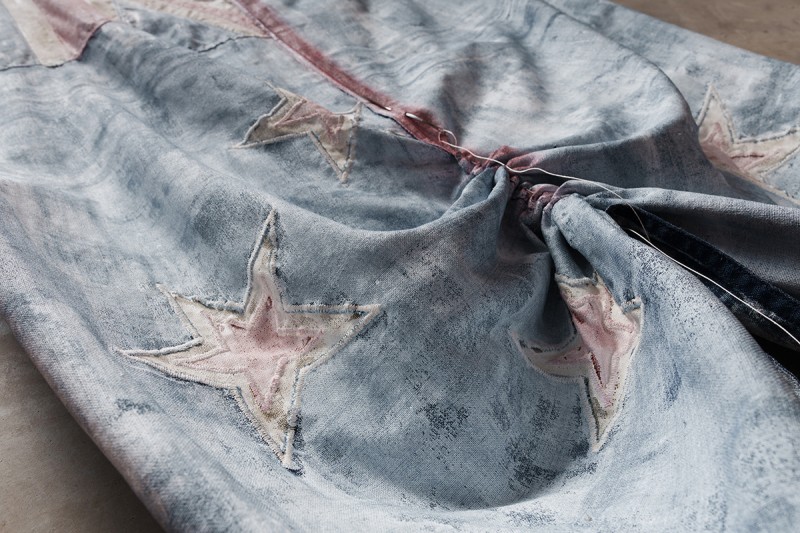
The works are physical and tactile. They comprise found and prefabricated materials that are mostly functional, mass produced, and familiar. Lace and ribbon and a synthetic whale bone coil recall colonial aesthetics, domesticity, and social etiquette. Heavy jute sacks used for grass-seed export of ryegrass and clover, and a weathered Union Jack altered with hand stitching, recall New Zealand’s positioning as a colonial outreach.
“I am interested in the proximity of brutality and beauty, in ornament, excess, power and control, and the ways that these ideas reveal themselves though sculptural means, such as the gates adorned with latches”, George continues.
The title The Choice pays homage to Robyn Kahukiwa’s famous painting of the same name that features symbolic associations around urban migration, assimilation, and what is inherited, systemic, and destined. “I think Robyn Kahukiwa is a luminary and an influence for many artists in Aotearoa. Rather than being stylistically influenced by her, I’ve always appreciated her staunch and seemingly uncompromising attitude towards working and living as an artist.”
While producing this collection, George was reading Dionne Brand’s book Salvage: Readings from the Wreck about the 19th-century novel. It “is a blend of autobiography and literary criticism, rereading classic English literature – such as Jane Eyre or Mansfield Park – to understand how they helped license colonialism, slavery, and imperialism, offering a kind of ‘script’ or template for social aspiration.” At the time she re-read Sense and Sensibility and Wuthering Heights, while also listening to lots of Charli xcx.
The interrogation and excavation of texts, textiles, architecture, and rural structures reveal colonial inheritances and the way these histories haunt us in the present. George is interested in the social and political function of allegory, and there is no starker one than cutting into the gallery wall to reveal its internal structures.
An artist living in Tūrangi-a-Kiwa Gisborne, this year she was awarded the Jann Medlicott Award for Contemporary Art. The “exhibition marks a departure for me in some ways, an attempt to think on a different scale and through different methods of install practice”, George says. “I wanted to move away from having discreet or autonomous objects in the space, in favour of a larger installation in which all the elements are interconnected.”
View more articles from:
« Issue 272, July 14, 2026