
Awestriking in Aotearoa by Madelaine Empson
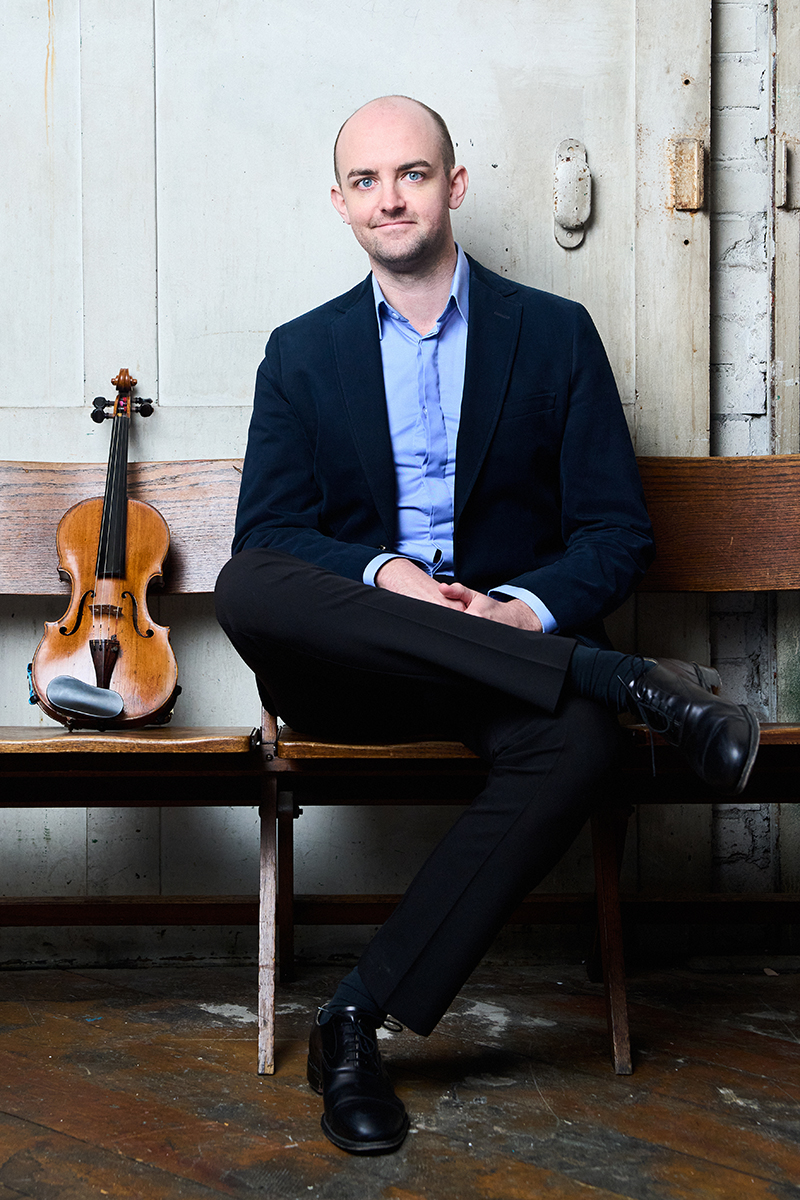
Benjamin Baker is a sought-after soloist and chamber musician around the globe. Described by The New York Times as bringing “virtuosity, refinement, and youthful exuberance” in concert, the Wellington-born, London-based violinist counts himself as one of the luckiest Kiwi expats.
“I get to come home for two months a year for AWE. So my schedule in perpetuity is that September and October are New Zealand months, and no one else gets a look in.”
AWE, which stands for At the World’s Edge Festival and which Baker co-founded with fellow violinist Justine Cormack in 2021, takes place annually in the Southern Alps. The globally renowned chamber music festival sets performances from local, national, and international musicians against awe-inspiring scenic backdrops and features seven curated programmes in Queenstown, Wānaka, Cromwell, and Bannockburn, with free community events throughout.
Baker, whose recent highlights include appearances at Wigmore Hall and on BBC Radio 3, plus debuts with the BBC National Orchestra of Wales, London Philharmonic Orchestra, Scottish Chamber Orchestra, and more, will be in Aotearoa for AWE from the 4th to the 17th of October. But first, he’ll join viola player Yura Lee to perform Mozart’s Sinfonia Concertante with Orchestra Wellington. Secrets will whisper through Michael Fowler Centre on the 20th of September at 7:30pm and is the fourth concert of Orchestra Wellington’s 2025 season, The Dictator’s Shadow.
What sparked your passion for violin?
My story began as a little kid in Wellington. I was three, and my mum had played the piano as a kid herself, and so she took me to some piano lessons to see if maybe I’d like it. It didn’t go very well. I decided my piano teacher was a witch [laughs]. I have since met that piano teacher, and she’s actually totally lovely, so I think it must’ve been that I was pretty sure, even at three years old, that the piano was not for me. As almost a last-ditch effort, my mum took me to a piano class concert of some of the students playing. At the very end of that concert, there was a violinist playing with piano. Apparently, I wandered up from the back of the hall, sat at this girl’s feet, and couldn’t take my eyes off her and the violin. And then I nagged my parents for a few months afterwards that I wanted to play ‘that guitar thing’.
That was the very beginning. From that point, my parents heard about the Suzuki Method, so my first memories of music were in the wonderful Suzuki community in Wellington. Like any instrument, the violin is challenging – but I do think that it has a tendency to sound like a strangled cat for quite a few years, really, as you learn to make a sound [laughs]. Sometimes, even after playing all my life, I’ll still be like, ‘Whoa! This is not sounding good today!’
It is universally accepted that the violin is up there with instruments that parents would not necessarily love their kids to learn...
[Laughs.] The beauty of something like piano is, once you’re learning that, you press a key and the sound is there. As violinists, we spend – let’s be real – our entire lives thinking about how to make a sound out of this miraculous wooden box. It never ends, that pursuit of trying to make a beautiful sound.
Do you remember the first piece that really struck you and the first time you were able to play it yourself?
Actually, yes! It was a recording that ended up being the catalyst for me leaving to study overseas. My parents had a recording of Nigel Kennedy’s The Four Seasons by Vivaldi at home. That was my first discovery of what a violin soloist could be, and Nigel Kennedy was my first violin idol. As a five, six, seven-year-old, I totally fell in love with that recording and with him. I remember reading in the line notes that he was from the UK, that he went to this specialist music school called the Yehudi Menuhin School, where he got to grow up and do normal subjects, but with music as the main focus. And I was like, well, that sounds kind of cool! Then when I was about seven, he came on tour to New Zealand and came to Michael Fowler Centre with the Auckland Philharmonia. Wellington being the wonderfully tight-knit community that it is, my dad managed to find the right person to ask if I could get backstage to meet Nigel. I went backstage with my little violin case, and I remember this really vividly. There he was. He was like, ‘Oh hey man, great to meet you.’ He’s a very cool guy. He saw my violin case and was like, ‘Oh hey, cool. You want to play something?’ The piece I was learning in my Suzuki book at the time happened to be Bach’s Concerto for Two Violins. I started playing Bach Double, which is a very famous piece, and he’s, of course, played it millions of times. So he just whipped out his violin and joined in, and we played the rest of the first movement together. It was the highlight of my life up until that point! He said something like, ‘Man, you got f**king good rhythm.’ My parents’ eyes shot through their hairlines [laughs]. But he then said, ‘Wow, you’re really talented. You should think about applying to the school that I grew up at.’ That began the process. I sent off a tape to the UK, and then maybe a year later, I went for a personal audition. About 18 months after meeting Nigel Kennedy, my family and I were moving to the UK. The Four Seasons and the Bach Double will forever be those pieces that were right at the beginning of this extraordinary journey that I’m lucky to still be on.
How and when did your relationship with Orchestra Wellington begin?
I was 11 or 12 years old when I made my concerto debut playing Mozart Violin Concerto in Istanbul, Turkey. That started a conversation of, can we do something back home in Wellington? It was a year later, just before I turned 13, that I came back home to play with Orchestra Wellington. I think it was called Wellington Sinfonia at that point. I came back then to play Bruch Violin Concerto, which was my first big Romantic violin concerto played with orchestra. It was a really significant moment in my musical life. To be doing it back home in Wellington was dream-come-true stuff.
And for your New Zealand visit this year, you’re performing as a soloist with Orchestra Wellington again. Could you tell me about the piece you’ll play with Yura Lee?
Absolutely. It’s been a real joy for AWE to begin this process of exploring with Orchestra Wellington how we can share some of the musicians we bring to New Zealand. This year, I’m pretty lucky that I get to be heavily involved. Yura Lee is, at least in my opinion, a legendary string player based in the US, originally from Korea, and just an extraordinary human – wonderful, wonderful musician. We’re thrilled to be able to bring her to Wellington to play Sinfonia Concertante with me.
It is a luminous piece of music. It’s one of those pieces that exudes beautiful, positive vibes, and it’s an interesting thing when you have two soloists with an orchestra. Most concertos are a single soloist, who is your protagonist, your hero of the story. As soon as you have two soloists, it takes on quite a few more dimensions, because suddenly you have interaction between two soloists, as well as each soloist with the orchestra, as well as both soloists with the orchestra. So with the number of interactions going on, it becomes a piece of, really, enormous scale chamber music. This piece encapsulates Mozart’s amazing ability to take a simple idea and produce something stunningly beautiful with it. It’s really one of the most joyous pieces of music. The middle movement is achingly beautiful. It’s one of those pieces that I think everyone should hear at some point.
What is AWE all about?
The ethos and the mission is about being a connecting point. Every year, we bring together established New Zealand artists, bring established international artists to New Zealand, and use that opportunity to also involve the emerging talent too. We bring together dimensions of connection: connecting geographically across borders, as well as across generations. It’s really a uniting force for the surrounding communities, and for our musicians too. We see it as our responsibility to share what we do with as wide a cross-section of the community as possible, and we finish in the local schools – the youngest ears in Central Otago. When all the musicians are feeling connected, and there’s a real community on stage and off stage, it all feeds into unique, powerful experiences. If your curiosity compels you to find out what it’s about, then you have to be there.
Is there a piece of music that you feel best defines your life right now?
That’s a hell of a question! A great big clanger, world-class! Actually, yes. One of the joys of my creative life is to have, through AWE, an outlet to be able to commission new music. I think the answer to your question would be one of our most-performed AWE commissions to date (commissioned in 2021 for our first festival), which is a string trio called Mata-Au by Salina Fisher. The Mata-Au River, also known as the Clutha River, begins in Lake Wānaka and flows throughout the South Island. That for her was of course inspired by coming to Queenstown, but also she is a Kiwi with Japanese heritage, so she works in the dual influences of the landscape – water flowing out and beginning on a long journey – and the fact that the title in Japanese is a homophonous phrase that means ‘to meet again’. As an expat Kiwi overseas, that expression of identity really resonates with me.
View more articles from:
« Issue 251, August 26, 2025