
Jasmine Togo-Brisby
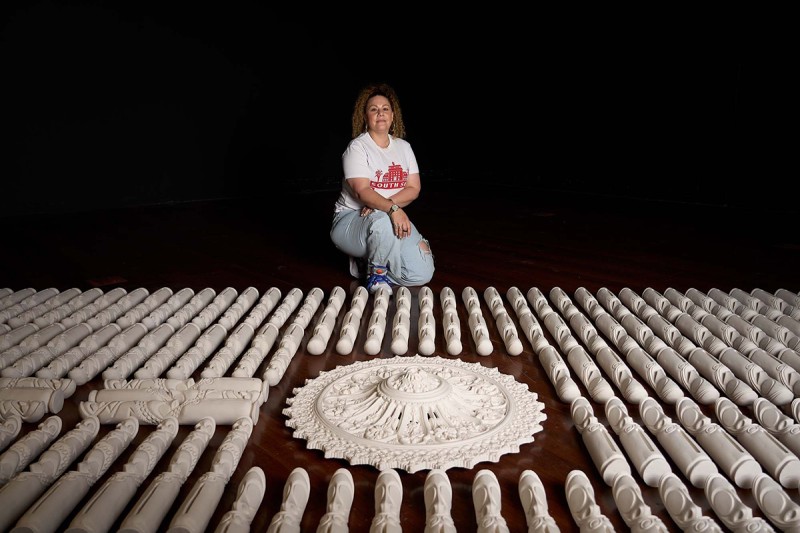
Photo by Sam Roberts
A place of belonging by Alessia Belsito-Riera
Ambitious and monumental, artist Jasmine Togo-Brisby’s practice aims to create a sense of place for Australian South Sea Islanders (ASSI).
“Her works are often incredibly large and are often displayed in large spaces where the space around the artworks become part of the experience,” Pātaka Art + Museum lead curator Ioana Gordon-Smith says. “Her style is also, perhaps surprisingly, quite minimal. She takes a concept or material and intentionally hones and pushes it to become something deeply impactful.”
The Brisbane-based, Australian South Sea Island creative has a soaring international profile, participating in the Asia Pacific Triennial, the Busan Biennale, the Bangkok Biennale, and the Adelaide Biennale in 2024 alone. She also has ties to Aotearoa. Having studied at Massey University – Te Kunenga ki Pūrehuroa in Wellington from 2015 to 2022, she credits Moana and Māori communities with supporting her artistic practice and encouraging her to make space for her Australian South Sea identity.
Her newest exhibition ungeographic takes over all of Pātaka’s gallery spaces until the 9th of November for a mid-career survey that interrogates the relationship ASSI have to place.
“It’s a tricky one. Because ASSI are a people born out of the forced movement between Pacific islands and Australia, they are clearly connected to multiple geographies, but they’re not often acknowledged in any,” Gordon-Smith says. “The exhibition frames Jasmine’s art practice as something of an alternative map or way of thinking about Australian South Sea Islander places of belonging.”
South Sea Islanders are the Australian-born descendants of people brought to Australia between 1847 and 1904 as indentured labourers, mainly to work in Queensland’s sugar and cotton plantations. Togo-Brisby’s own great-great-grandparents were taken from Vanuatu as part of the Pacific slave trade, a practice that saw people shipped from over 80 Moana islands.
Working across installation, video, photography, and sculpture, Togo-Brisby draws on archival research, her own family history, and motifs associated with Australian South Sea Islanders, Gordon-Smith says, adding that her approach combines different contextual references together to deliberately cross and straddle geographic borders. “Her work suggests that some materials themselves might be considered a place of belonging. There are materials that deliberately reappear in her work – sugar and crow feathers, for instance, which offer a strong sense of grounding, identity, history, and belonging”.
Visitors will come across several significant pieces from across Aotearoa and Australia, including sugar works from Queensland, large-scale plaster works from Sydney, a suspended ship work from Auckland, and some feather sculptures and photographs from Togo-Brisby’s personal collection.
A new and impressive publication designed by award-winning studio Extended Whānau also accompanies ungeographic. It features texts by Togo-Brisby, her sister and studio manager Simone Togo-Brisby, curator Gordon-Smith, Anna Arabindan-Kesson, Ruth McDougall, Imelda Miller, and Nina Tonga.
“Despite having connections to so many nations, Australian South Sea Islanders are often not seen as belonging to any,” Gordon-Smith says. “In her artwork, Jasmine seeks to create a visual identity specific to them.”
View more articles from:
« Issue 249, July 29, 2025